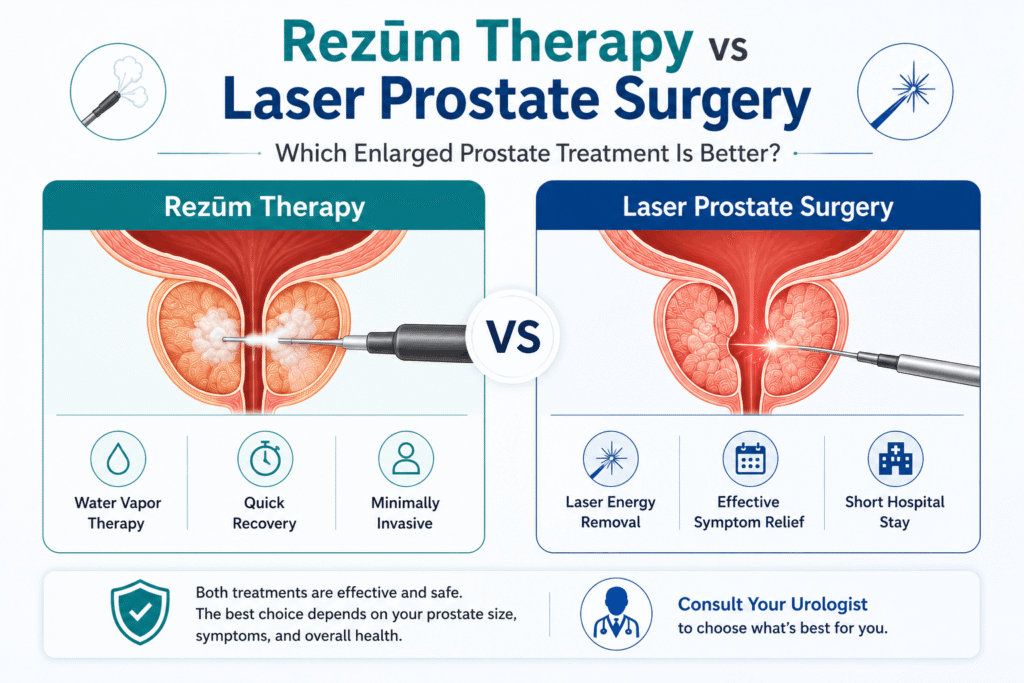
Rezūm vs Laser Prostate Surgery is one of the most common comparisons for men exploring treatment options for an enlarged prostate (Benign Prostatic Hyperplasia or BPH). Both procedures are effective but use different techniques to relieve urinary symptoms. Rezūm Therapy uses targeted water vapor (steam) to shrink enlarged prostate tissue over time, while Laser Prostate Surgery removes or vaporizes obstructing tissue using advanced laser technology. The most suitable treatment depends on prostate size, urinary symptoms, overall health, and individual treatment goals.
Quick Answer
Both Rezūm Therapy and Laser Prostate Surgery are established treatments for enlarged prostate (BPH), but they are designed for different clinical situations.
- Rezūm Therapy is a minimally invasive procedure that delivers controlled water vapor into the prostate to reduce excess tissue gradually.
- Laser Prostate Surgery is a surgical treatment that removes or vaporizes enlarged prostate tissue using laser technology to improve urine flow.
Neither treatment is universally better. The right choice depends on prostate size, urinary symptoms, medical history, prostate anatomy, and recommendations from an experienced urologist.
Introduction
When medications are no longer effective in controlling urinary symptoms caused by an enlarged prostate, many men consider procedural treatment options. Two commonly recommended approaches are Rezūm Therapy and laser prostate surgery.
Although both procedures are designed to relieve urinary obstruction and improve quality of life, they differ in their technique, recovery, hospital stay, and suitability for different patients.
This guide compares Rezūm Therapy vs Laser Prostate Surgery to help you understand how each treatment works, who may benefit, expected recovery, potential advantages, limitations, and the factors doctors consider when recommending one procedure over the other.
What Is Benign Prostatic Hyperplasia (BPH)?
Benign Prostatic Hyperplasia (BPH) is a non-cancerous enlargement of the prostate gland that commonly develops as men age. As the prostate grows, it can compress the urethra, making it more difficult for urine to pass from the bladder.
Common symptoms include:
- Frequent urination
- Weak urine stream
- Difficulty starting urination
- Urinary urgency
- Interrupted urine flow
- Nocturia (frequent nighttime urination)
- Feeling of incomplete bladder emptying
Without appropriate treatment, BPH may lead to complications such as urinary retention, recurrent urinary tract infections, bladder stones, and bladder damage.
Why Compare Rezūm and Laser Prostate Surgery?
Although both treatments improve urinary flow, they achieve this in different ways.
Rezūm Therapy uses natural water vapor energy to shrink enlarged prostate tissue gradually, while Laser Prostate Surgery removes or vaporizes obstructing tissue immediately using specialized laser technology.
Understanding these differences helps patients choose the treatment that best matches their condition, lifestyle, recovery expectations, and long-term treatment goals.
Similarities Between Rezūm and Laser Prostate Surgery
Both treatments:
- Treat urinary symptoms caused by BPH
- Improve urine flow
- Are performed by trained urologists
- Require no external surgical incision
- Aim to improve quality of life
- Require proper patient evaluation before treatment
- Have established clinical evidence supporting their use
Major Differences at a Glance
| Feature | Rezūm Therapy | Laser Prostate Surgery |
|---|---|---|
| Treatment Type | Minimally invasive | Surgical |
| Energy Used | Water vapor (steam) | Laser energy |
| Tissue Removal | No (tissue shrinks naturally) | Yes (tissue is removed or vaporized) |
| Hospital Stay | Usually same day | Same day or short hospital stay |
| Recovery | Gradual improvement | Often quicker symptom improvement after healing |
| General Anesthesia | Often not required | Commonly required |
| Suitable for Larger Prostates | Selected patients | Often suitable for moderate to larger prostates after evaluation |
Rezūm vs Laser Prostate Surgery: A Detailed Comparison
Both Rezūm Therapy and Laser Prostate Surgery are effective treatment options for Benign Prostatic Hyperplasia (BPH). Although both procedures are designed to relieve urinary obstruction caused by an enlarged prostate, they differ in how they work, recovery time, patient suitability, and treatment goals.
Understanding these differences can help patients have a more informed discussion with their urologist when deciding on the most appropriate treatment.
What Is Rezūm Therapy?
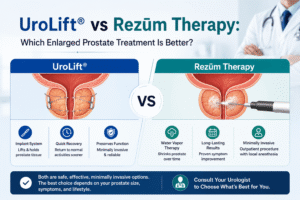
Rezūm Therapy is a minimally invasive treatment for enlarged prostate that uses the natural energy stored in water vapor (steam) to reduce excess prostate tissue.
Unlike traditional surgery, Rezūm does not remove prostate tissue immediately. Instead, controlled water vapor is injected into targeted areas of the prostate. Over the following weeks, the treated tissue is gradually absorbed by the body, helping to open the urinary passage and improve urine flow.
How Does Rezūm Therapy Work?
During the procedure:
- A specialized device is inserted through the urethra.
- Small amounts of sterile water vapor are delivered into enlarged prostate tissue.
- The steam releases thermal energy that treats the targeted cells.
- Over time, the body naturally absorbs the treated tissue.
- As swelling decreases, urinary symptoms gradually improve.
Because no external incision is required, Rezūm is commonly performed as a day-care procedure.
Who May Be a Suitable Candidate for Rezūm Therapy?
Rezūm Therapy may be considered for patients who:
- Have mild to moderate urinary symptoms caused by BPH
- Prefer a minimally invasive treatment
- Wish to avoid major surgery
- Have not achieved adequate relief with medications
- Are suitable candidates based on prostate size and anatomy
The final decision is based on a detailed evaluation performed by a qualified urologist.
Advantages of Rezūm Therapy
Potential advantages include:
- Minimally invasive procedure
- No external incision
- Usually performed as a day-care treatment
- Uses natural water vapor energy
- Gradual reduction of enlarged prostate tissue
- Short procedure duration
- Lower bleeding risk compared with many surgical procedures
Limitations of Rezūm Therapy
Rezūm may not be appropriate for every patient.
Some limitations include:
- Symptom improvement is gradual rather than immediate
- Temporary urinary symptoms may occur during recovery
- A urinary catheter may be required for a short period
- Careful patient selection is essential
Recovery After Rezūm Therapy
Recovery varies from patient to patient.
Many individuals:
- Return home the same day
- Resume light activities within several days
- Experience gradual symptom improvement over the following weeks
- Attend scheduled follow-up visits to monitor recovery
The timeline depends on healing, prostate size, and overall health.
What Is Laser Prostate Surgery?
Laser Prostate Surgery is a surgical treatment that removes or vaporizes enlarged prostate tissue using high-energy laser technology.
Unlike Rezūm, Laser Surgery removes obstructing tissue during the procedure, allowing urine to flow more freely once healing progresses.
Several laser techniques are available, and the most suitable approach depends on the patient’s condition and the surgeon’s expertise.
How Does Laser Prostate Surgery Work?
During the procedure:
- A laser instrument is inserted through the urethra.
- Laser energy precisely removes or vaporizes enlarged prostate tissue.
- The urinary passage is widened immediately after tissue removal.
- No external surgical incision is required.
The procedure is performed under anesthesia in a hospital or specialized surgical center.
Who May Be a Suitable Candidate for Laser Prostate Surgery?
Laser Surgery may be recommended for patients who:
- Have moderate to severe urinary symptoms
- Have significant urinary obstruction
- Have not responded adequately to medication
- May benefit from surgical removal of enlarged tissue
- Are considered suitable after specialist evaluation
Only a qualified urologist can determine whether laser surgery is the right option.
Advantages of Laser Prostate Surgery
Potential benefits include:
- Effective removal of obstructing tissue
- Immediate widening of the urinary channel
- No external incision
- Precision treatment using laser energy
- Often associated with reduced bleeding compared with traditional surgery
- Long-established clinical use
Limitations of Laser Prostate Surgery
Some considerations include:
- Requires anesthesia
- Usually involves hospital-based treatment
- Temporary catheterization is often required
- Recovery may take several weeks
- Follow-up care is necessary
Recovery After Laser Prostate Surgery
Recovery generally includes:
- Observation in hospital or same-day discharge depending on the procedure
- Temporary urinary catheter
- Gradual return to normal daily activities
- Follow-up visits to monitor healing and urinary function
Recovery time depends on the laser technique used, prostate size, and individual health.
Rezūm Therapy vs Laser Prostate Surgery: Side-by-Side Overview
| Feature | Rezūm Therapy | Laser Prostate Surgery |
|---|---|---|
| Treatment Type | Minimally invasive | Surgical |
| Tissue Removal | No | Yes |
| Energy Source | Water vapor | Laser energy |
| External Incision | No | No |
| Hospital Stay | Usually same day | Same day or short stay |
| Recovery | Gradual | Longer but tissue removed immediately |
| General Anesthesia | Often not required | Usually required |
| Catheter Requirement | Often temporary | Commonly temporary |
| Return to Work | Usually within several days | Usually within a few weeks |
How Do Doctors Choose Between Rezūm Therapy and Laser Surgery?
Choosing the most appropriate treatment requires a comprehensive assessment.
Doctors commonly evaluate:
- Prostate size
- Severity of urinary symptoms
- Bladder function
- Medical history
- Current medications
- Age and overall health
- Lifestyle
- Recovery expectations
- Personal treatment goals
No single procedure is suitable for every patient. Treatment decisions are personalized after careful evaluation.
Key Takeaways
- Both Rezūm Therapy and Laser Prostate Surgery effectively treat enlarged prostate symptoms.
- Rezūm uses water vapor to shrink prostate tissue gradually, while Laser Surgery removes obstructing tissue during the procedure.
- Rezūm is minimally invasive and generally offers a shorter initial recovery period.
- Laser Surgery provides immediate removal of enlarged tissue and is often considered for patients with more significant obstruction.
- The most appropriate treatment depends on prostate anatomy, symptom severity, and expert medical evaluation.
Rezūm Therapy vs Laser Prostate Surgery: Side-by-Side Comparison
Choosing between Rezūm Therapy and Laser Prostate Surgery depends on several factors, including prostate size, urinary symptoms, overall health, lifestyle, and recovery expectations. While both procedures are effective for treating Benign Prostatic Hyperplasia (BPH), they differ in how they relieve urinary obstruction and the type of recovery patients can expect.
The comparison below explains the key differences to help you better understand both treatment options before consulting a qualified urologist.
Quick Comparison Table
| Feature | Rezūm Therapy | Laser Prostate Surgery |
|---|---|---|
| Treatment Type | Minimally invasive | Surgical |
| Technology | Water vapor (steam) | Laser energy |
| Tissue Removal | No | Yes |
| External Incision | No | No |
| Hospital Stay | Usually same day | Same day or short hospital stay |
| General Anesthesia | Often not required | Usually required |
| Recovery | Gradual improvement | Longer healing but immediate tissue removal |
| Catheter Requirement | Often temporary | Commonly temporary |
| Return to Routine Activities | Usually within several days | Usually within a few weeks |
| Suitable for Larger Prostates | Selected patients | Often suitable after evaluation |
Procedure Duration
Both procedures are performed through the urethra without external cuts.
Rezūm Therapy
- Usually completed within 30–60 minutes.
- Often performed as a day-care procedure.
- Patients generally return home on the same day.
Laser Prostate Surgery
- Usually completed within one to two hours depending on the surgical technique and prostate size.
- Performed in a hospital or specialized surgical center.
Procedure time may vary according to prostate anatomy and the complexity of the case.
Recovery Time
Recovery is one of the most important considerations when choosing a BPH treatment.
Recovery After Rezūm Therapy
Many patients:
- Return home the same day
- Resume light daily activities within a few days
- Experience gradual improvement over several weeks as the body absorbs treated tissue
- Attend follow-up visits to assess healing
Recovery After Laser Prostate Surgery
Recovery generally includes:
- Observation in hospital or short hospital stay
- Temporary urinary catheter
- Gradual healing over several weeks
- Follow-up appointments to monitor urinary function
The recovery timeline varies depending on the laser technique used and individual health.
Hospital Stay
Rezūm Therapy
Usually performed as an outpatient procedure, allowing most patients to return home the same day.
Laser Prostate Surgery
Many patients are discharged the same day or after a short hospital stay, depending on the procedure and recovery.
Catheter Requirement
Rezūm Therapy
A temporary urinary catheter is commonly used for several days after the procedure to support healing.
Laser Prostate Surgery
A catheter is also commonly required after surgery and is removed once the urologist confirms adequate recovery.
Effectiveness
Both Rezūm Therapy and Laser Prostate Surgery aim to improve urinary symptoms caused by BPH.
Patients often notice improvement in:
- Weak urine stream
- Frequent urination
- Nighttime urination (nocturia)
- Difficulty starting urination
- Urinary urgency
- Feeling of incomplete bladder emptying
The level of improvement depends on:
- Prostate size
- Bladder function
- Severity of symptoms
- Overall health
- Individual healing response
Which Treatment Provides Faster Symptom Relief?
One of the biggest differences between these procedures is how quickly patients notice improvement.
Rezūm Therapy
Because the body gradually absorbs the treated prostate tissue, symptom improvement usually develops over several weeks.
Laser Prostate Surgery
Since obstructing tissue is removed during the procedure, many patients experience improved urine flow sooner after the initial recovery period.
The recovery experience differs among individuals.
Which Treatment Is Better for Younger Men?
Younger patients often consider:
- Recovery time
- Return to work
- Long-term quality of life
- Lifestyle
- Future treatment needs
Depending on prostate anatomy and clinical findings, either Rezūm Therapy or Laser Surgery may be appropriate.
Age alone does not determine the most suitable treatment.
Which Treatment Is Better for Older Adults?
Older patients may have additional medical considerations such as:
- Heart disease
- Diabetes
- Kidney disease
- High blood pressure
- Blood-thinning medications
These health factors influence treatment recommendations.
An experienced urologist will evaluate overall health before recommending either procedure.
Which Treatment Is More Suitable for Larger Prostates?
Prostate size is one of the most important factors in treatment selection.
Rezūm Therapy may be appropriate for selected patients based on prostate anatomy and clinical assessment.
Laser Prostate Surgery is frequently considered for patients with moderate to larger prostates because it directly removes obstructing tissue.
The final decision depends on imaging findings and specialist evaluation.
Bleeding Risk
Both procedures generally avoid external incisions, but their bleeding profiles differ.
- Rezūm Therapy typically causes minimal bleeding because no tissue is surgically removed.
- Laser Prostate Surgery is often associated with less bleeding than traditional surgical techniques due to the laser’s ability to seal blood vessels while treating tissue.
Patients taking blood-thinning medications should discuss treatment options with their urologist.
Long-Term Symptom Relief
Both procedures can provide long-term improvement when patients are appropriately selected.
Successful outcomes depend on:
- Accurate diagnosis
- Proper patient selection
- Urologist experience
- Follow-up care
- Healthy lifestyle habits
- Management of other medical conditions
Regular follow-up helps monitor long-term urinary health regardless of the treatment chosen.
Cost Considerations
The cost of treatment varies depending on:
- Hospital
- City
- Technology used
- Surgeon’s expertise
- Hospital stay
- Diagnostic investigations
- Insurance coverage
Patients should choose the treatment that is medically appropriate rather than focusing solely on cost.
Questions to Ask Your Urologist
Before deciding between Rezūm Therapy and Laser Prostate Surgery, consider asking:
- Am I a suitable candidate for Rezūm Therapy?
- Is Laser Surgery recommended for my prostate size?
- How long will recovery take?
- Will I need a catheter after treatment?
- When can I return to work?
- What follow-up care is required?
- Are there alternative minimally invasive options available?
- Which treatment best matches my symptoms and overall health?
Expert Opinion
Both Rezūm Therapy and Laser Prostate Surgery are proven treatment options for men with enlarged prostate.
Neither procedure is universally better. The most appropriate treatment depends on prostate size, urinary symptoms, bladder function, overall health, and individual treatment goals.
A personalized evaluation by an experienced urologist is essential to determine the safest and most effective option.
Key Takeaways
- Both Rezūm Therapy and Laser Prostate Surgery effectively relieve urinary symptoms caused by BPH.
- Rezūm uses water vapor to shrink prostate tissue gradually without removing tissue.
- Laser Surgery removes obstructing prostate tissue using advanced laser technology.
- Rezūm generally involves a shorter initial recovery, while Laser Surgery offers immediate removal of obstructing tissue.
- The most appropriate treatment depends on prostate anatomy, symptom severity, medical history, and expert clinical assessment.
Frequently Asked Questions (FAQs)
1. Which is better, Rezūm Therapy or Laser Prostate Surgery?
There is no single treatment that is best for every patient. Both Rezūm Therapy and Laser Prostate Surgery are effective treatments for Benign Prostatic Hyperplasia (BPH). The most suitable option depends on prostate size, urinary symptoms, prostate anatomy, overall health, and individual treatment goals.
2. What is the main difference between Rezūm Therapy and Laser Prostate Surgery?
Rezūm Therapy uses controlled water vapor (steam) to shrink enlarged prostate tissue gradually over time. Laser Prostate Surgery removes or vaporizes obstructing prostate tissue using laser energy during the procedure.
3. Which treatment offers faster recovery?
Many patients resume light activities within a few days after Rezūm Therapy, but urinary symptom improvement is usually gradual. Laser Prostate Surgery involves a longer healing period, although obstructing tissue is removed during the procedure.
4. Is Rezūm Therapy less invasive than Laser Surgery?
Yes. Rezūm Therapy is considered a minimally invasive treatment that uses water vapor without surgically removing tissue. Laser Prostate Surgery is a surgical procedure that removes or vaporizes enlarged prostate tissue.
5. Which treatment provides better long-term symptom relief?
Both treatments can provide durable symptom relief when patients are appropriately selected. Long-term outcomes depend on prostate size, urinary symptoms, overall health, and ongoing follow-up with a qualified urologist.
6. Will I need a urinary catheter after treatment?
Many patients require a temporary urinary catheter after both Rezūm Therapy and Laser Prostate Surgery. The duration depends on the procedure performed and the individual’s recovery.
7. Which treatment is suitable for larger prostates?
Laser Prostate Surgery is commonly considered for patients with moderate to larger prostates after clinical evaluation. Rezūm Therapy may also be suitable for selected patients depending on prostate anatomy and specialist assessment.
8. Can both procedures improve urinary symptoms?
Yes. Both procedures are designed to improve common BPH symptoms, including weak urine stream, frequent urination, urgency, nighttime urination, and incomplete bladder emptying.
9. Are both treatments performed without external incisions?
Yes. Both Rezūm Therapy and Laser Prostate Surgery are performed through the urethra without making external surgical incisions.
10. Which treatment allows a quicker return to work?
Many patients who undergo Rezūm Therapy return to routine activities sooner. Recovery after Laser Prostate Surgery may take longer depending on the surgical technique and the individual’s health.
11. How do doctors decide between Rezūm Therapy and Laser Surgery?
Doctors evaluate several factors, including:
- Prostate size
- Urinary symptoms
- Bladder function
- Overall health
- Medical history
- Current medications
- Lifestyle
- Recovery expectations
- Personal treatment goals
A thorough clinical assessment helps determine the most appropriate treatment.
12. Should I choose treatment based only on cost?
No. Treatment decisions should be based primarily on medical suitability, expected outcomes, and expert advice rather than cost alone.
Conclusion
Both Rezūm Therapy and laser prostate surgery are proven treatment options for men experiencing urinary symptoms caused by Benign Prostatic Hyperplasia (BPH). Although both procedures aim to improve urine flow and quality of life, they work differently and are recommended for different clinical situations.
Rezūm Therapy offers a minimally invasive approach that gradually reduces enlarged prostate tissue using water vapor, making it an attractive option for appropriately selected patients seeking a less invasive treatment. Laser Prostate Surgery removes or vaporizes obstructing tissue during the procedure and is often recommended for patients with more significant urinary obstruction or larger prostates.
Rather than asking which treatment is universally better, the focus should be on identifying the procedure that best matches your prostate size, urinary symptoms, overall health, and personal preferences. A consultation with an experienced urologist is the best way to choose the most suitable treatment plan.
Confused Between Rezūm Therapy and Laser Prostate Surgery?
Every enlarged prostate is different, which is why treatment should always be tailored to your specific condition.
Dr. Priyaddarshi Ranjan specializes in advanced minimally invasive and surgical BPH treatments. After a comprehensive evaluation, he can help determine whether Rezūm Therapy, Laser Prostate Surgery, UroLift®, TURP, Aquablation Therapy, iTind, or PAE is the most appropriate option for you.
Schedule your consultation today to receive a personalized treatment plan and take the first step toward long-lasting relief from enlarged prostate symptoms.