Both UroLift® and Rezūm Water Vapor Therapy are minimally invasive treatments for Benign Prostatic Hyperplasia (BPH). UroLift® uses permanent implants to hold enlarged prostate tissue away from the urethra, while Rezūm Therapy uses controlled water vapor to treat excess prostate tissue. Neither treatment is universally better; the ideal option depends on prostate size, anatomy, urinary symptoms, overall health, and patient preferences. An experienced urologist can recommend the most appropriate treatment after a comprehensive evaluation.
If you’ve been diagnosed with Benign Prostatic Hyperplasia (BPH), you’ve likely come across two of the most popular minimally invasive treatment options: UroLift® and Rezūm Water Vapor Therapy. Both procedures are designed to relieve urinary symptoms caused by an enlarged prostate while offering shorter recovery times than traditional surgery.
Choosing between them can be challenging because each treatment works differently and may be more suitable for certain patients based on prostate anatomy, symptom severity, and individual treatment goals.
This comprehensive guide compares UroLift vs Rezūm to help you understand how each procedure works, their benefits, recovery expectations, potential limitations, and the factors doctors consider when recommending one over the other.
Quick Answer
Both UroLift® and Rezūm Therapy are effective minimally invasive treatments for appropriately selected men with BPH.
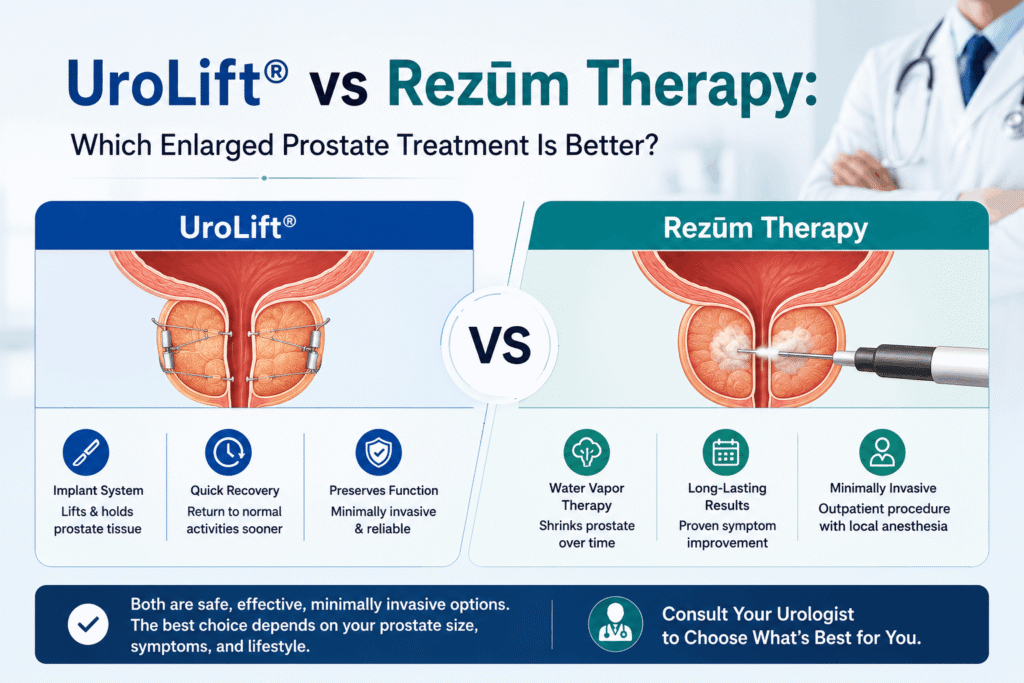
- UroLift® uses small permanent implants to hold enlarged prostate tissue away from the urethra, improving urine flow without removing tissue.
- Rezūm Therapy uses controlled water vapor (steam) to treat excess prostate tissue, which the body gradually absorbs over time.
Neither treatment is universally better. The most appropriate option depends on factors such as prostate size, urinary symptoms, prostate anatomy, overall health, and personal treatment preferences. A qualified urologist can determine which approach is most suitable after a thorough evaluation.
What Is Benign Prostatic Hyperplasia (BPH)?
Benign Prostatic Hyperplasia (BPH), commonly known as an enlarged prostate, is a non-cancerous enlargement of the prostate gland that affects many men as they age. As the prostate grows, it can compress the urethra and interfere with normal urine flow.
Common symptoms include:
- Frequent urination
- Urgency to urinate
- Weak urine stream
- Difficulty starting urination
- Interrupted urine flow
- Feeling that the bladder is not completely empty
- Frequent nighttime urination (nocturia)
If left untreated, BPH may lead to complications such as urinary retention, recurrent urinary tract infections, bladder stones, or kidney problems.
Fortunately, minimally invasive procedures like UroLift® and Rezūm Therapy provide effective alternatives to conventional surgery for many patients.
Why Compare UroLift® and Rezūm Therapy?
Both procedures have become popular because they aim to improve urinary symptoms while reducing hospital stay and recovery time compared with traditional surgical treatments.
However, they differ in how they relieve obstruction:
- UroLift® mechanically opens the urethra using permanent implants.
- Rezūm Therapy uses the thermal energy of water vapor to treat excess prostate tissue.
Understanding these differences helps patients have informed discussions with their urologist and choose the treatment that best aligns with their medical condition and personal priorities.
Similarities Between UroLift® and Rezūm Therapy
Although the techniques are different, the two procedures share several important characteristics:
- Both are minimally invasive treatments for BPH.
- Both are designed to improve urinary symptoms caused by an enlarged prostate.
- Both are commonly performed as day-care or short-stay procedures.
- Neither requires an external surgical incision.
- Both generally involve shorter recovery than traditional prostate surgery.
- Both require careful patient selection to achieve the best outcomes.
Factors Doctors Consider Before Choosing Between UroLift® and Rezūm
Treatment recommendations are based on a comprehensive clinical assessment rather than patient preference alone. Important considerations include:
- Prostate size
- Shape and anatomy of the prostate
- Severity of urinary symptoms
- Bladder function
- Overall health
- Current medications
- Previous prostate treatments
- Lifestyle and recovery expectations
- Individual treatment goals
A personalized evaluation helps determine whether UroLift®, Rezūm Therapy, or another BPH treatment is the most appropriate option.
UroLift® vs Rezūm Therapy: A Detailed Comparison
Both UroLift® and Rezūm Water Vapor Therapy are advanced minimally invasive treatments for Benign Prostatic Hyperplasia (BPH). While both procedures aim to relieve urinary symptoms caused by an enlarged prostate, they use different techniques and may be recommended for different types of patients.
Understanding how each treatment works can help you have a more informed discussion with your urologist and choose the option that best suits your medical needs.
What Is the UroLift® System?
The UroLift® System is a minimally invasive BPH treatment that relieves urinary obstruction without removing or destroying prostate tissue. Instead, it uses tiny permanent implants to gently hold the enlarged prostate tissue away from the urethra, allowing urine to flow more freely.
Unlike many surgical treatments, UroLift does not involve cutting, heating, or removing prostate tissue.
How Does UroLift® Work?
During the procedure, a urologist inserts a specialized delivery device through the urethra. Small implants are placed into the prostate to lift and retract the enlarged tissue away from the urinary passage.
This creates an open channel for urine flow while leaving the prostate tissue intact.
The procedure is usually completed within an hour and is commonly performed as a day-care treatment.
Who May Be a Suitable Candidate for UroLift®?
UroLift may be considered for men who:
- Have mild to moderate BPH symptoms
- Have small to medium-sized prostates
- Want a minimally invasive treatment
- Prefer a shorter recovery period
- Wish to avoid removal of prostate tissue
A detailed medical evaluation is necessary to determine whether UroLift is appropriate, as certain prostate anatomies may not be suitable.
Advantages of UroLift®
Some potential benefits include:
- No external incision
- No cutting of prostate tissue
- No removal of tissue
- Usually performed as a day-care procedure
- Rapid improvement in urine flow for many patients
- Short recovery period
- Lower risk of certain sexual side effects in appropriately selected patients
Limitations of UroLift®
Although UroLift offers several advantages, it may not be suitable for everyone.
Possible limitations include:
- Not recommended for all prostate sizes
- Suitability depends on prostate anatomy
- Permanent implants remain inside the prostate
- Careful patient selection is essential
Recovery After UroLift®
Many patients:
- Return home the same day
- Resume light activities within a few days
- Experience gradual improvement in urinary symptoms
- Attend follow-up appointments to monitor recovery
Recovery varies depending on individual health and the severity of symptoms.
What Is Rezūm Water Vapor Therapy?
Rezūm Therapy is another minimally invasive BPH treatment that uses the natural energy stored in water vapor (steam) to treat excess prostate tissue.
Instead of physically removing tissue, Rezūm delivers controlled steam into the enlarged areas of the prostate. The treated tissue is gradually absorbed by the body over time, reducing obstruction and improving urine flow.
How Does Rezūm Therapy Work?
A specialized instrument is inserted through the urethra.
Controlled bursts of sterile water vapor are delivered into selected areas of the enlarged prostate.
The thermal energy destroys targeted prostate cells while preserving surrounding structures. Over the following weeks, the body naturally absorbs the treated tissue, allowing the urethra to open gradually.
Who May Be a Suitable Candidate for Rezūm?
Rezūm may be considered for men who:
- Have moderate urinary symptoms
- Want a minimally invasive treatment
- Prefer to avoid traditional surgery
- Are appropriate candidates based on prostate size and anatomy
Only a qualified urologist can determine whether Rezūm is suitable after clinical evaluation.
Advantages of Rezūm Therapy
Potential benefits include:
- No external incision
- Outpatient procedure
- Minimal blood loss
- Short treatment time
- Gradual improvement in urine flow
- Short recovery period for many patients
Limitations of Rezūm Therapy
Some considerations include:
- Symptom improvement is gradual
- Temporary urinary catheterization may be required
- Mild urinary discomfort may occur during healing
- Results depend on prostate anatomy and patient selection
Recovery After Rezūm Therapy
Recovery commonly includes:
- Going home the same day
- Temporary catheter for some patients
- Gradual improvement over several weeks
- Follow-up visits to assess progress
Although recovery is generally quick, complete symptom improvement usually occurs gradually as the treated tissue is absorbed.
UroLift® vs Rezūm: Side-by-Side Overview
| Feature | UroLift® | Rezūm Therapy |
|---|---|---|
| Treatment Type | Mechanical implants | Water vapor therapy |
| Tissue Removal | No | Tissue gradually absorbed |
| External Incision | No | No |
| Hospital Stay | Usually same day | Usually same day |
| Recovery | Fast | Fast, but symptom improvement is gradual |
| Procedure Time | Usually less than an hour | Usually less than an hour |
| General Anesthesia | Often not required | Often not required |
| Suitable for Selected Patients | Yes | Yes |
How Do Doctors Decide Between UroLift® and Rezūm?
There is no universally better option.
Doctors evaluate:
- Prostate size
- Shape of the prostate
- Severity of symptoms
- Urinary flow
- Bladder function
- Medical history
- Current medications
- Lifestyle
- Recovery expectations
- Personal treatment goals
A comprehensive evaluation helps identify which procedure is more appropriate for an individual patient.
Key Takeaways
- Both UroLift® and Rezūm Therapy are minimally invasive treatments for BPH.
- UroLift uses small implants to open the urethra, while Rezūm uses water vapor to treat enlarged prostate tissue.
- Both procedures are typically performed as day-care treatments and offer shorter recovery than traditional surgery.
- Treatment selection depends on prostate anatomy, symptom severity, overall health, and patient preferences.
- An experienced urologist can recommend the most appropriate option after a detailed evaluation.
UroLift® vs Rezūm Therapy: Side-by-Side Comparison
Choosing between UroLift® and Rezūm Water Vapor Therapy involves more than comparing two procedures. Your urologist will consider factors such as prostate size, urinary symptoms, overall health, lifestyle, and treatment goals before recommending the most appropriate option.
The following comparison highlights the key differences and similarities between these two minimally invasive BPH treatments.
Quick Comparison Table
| Feature | UroLift® | Rezūm Therapy |
|---|---|---|
| Procedure Type | Permanent implants | Water vapor (steam) therapy |
| Tissue Removed | No | Treated tissue is naturally absorbed |
| External Incision | No | No |
| Hospital Stay | Usually same day | Usually same day |
| Recovery Time | Fast | Fast, with gradual symptom improvement |
| Catheter Requirement | May not be required in selected patients | Temporary catheter is more commonly required |
| General Anesthesia | Often not required | Often not required |
| Return to Daily Activities | Usually within a few days | Usually within a few days |
| Long-Term Follow-up | Yes | Yes |
Procedure Duration
Both treatments are relatively short procedures.
- UroLift® is typically completed within an hour.
- Rezūm Therapy also generally takes less than an hour.
The exact duration depends on prostate anatomy and the number of implants or steam injections required.
Recovery Time
Recovery is one of the biggest reasons patients consider minimally invasive treatments.
UroLift®
Many patients:
- Return home the same day
- Resume light activities within a few days
- Notice improvement in urinary flow relatively soon
Rezūm Therapy
Many patients:
- Return home the same day
- Resume routine activities within a few days
- Experience gradual symptom improvement over several weeks as the treated tissue is naturally absorbed
Catheter Requirement
One important difference between the two procedures is the likelihood of temporary catheterization.
UroLift®
Some patients may not require a catheter after the procedure, while others may need one for a short period depending on their individual condition.
Rezūm Therapy
A temporary urinary catheter is more commonly used after Rezūm Therapy to support healing during the early recovery period.
The need for catheterization varies from patient to patient.
Effectiveness
Both procedures are designed to improve urinary symptoms associated with BPH.
Patients commonly report improvement in:
- Urine flow
- Urinary frequency
- Urgency
- Nighttime urination
- Feeling of incomplete bladder emptying
- Overall quality of life
The degree of improvement depends on:
- Prostate size
- Severity of symptoms
- Overall bladder function
- Individual healing response
Durability
Both UroLift® and Rezūm are intended to provide lasting symptom relief for appropriately selected patients.
Long-term outcomes depend on:
- Accurate diagnosis
- Proper patient selection
- Surgical expertise
- Follow-up care
- Lifestyle factors
Regular follow-up appointments remain important regardless of the treatment chosen.
Which Procedure Is Less Invasive?
Both procedures are considered minimally invasive because they:
- Do not require external incisions
- Usually involve a short hospital stay
- Offer faster recovery than traditional prostate surgery
- Can often be performed on a day-care basis
The main difference lies in how urinary obstruction is relieved:
- UroLift® mechanically opens the urethra using implants.
- Rezūm Therapy reduces excess prostate tissue using controlled water vapor.
Which Treatment Works Faster?
Many patients notice symptom improvement relatively soon after UroLift®, as the implants immediately open the urethral passage.
With Rezūm Therapy, improvement usually occurs more gradually because the body needs time to absorb the treated prostate tissue.
The exact timeline varies among individuals and should be discussed with your treating urologist.
Which Treatment Is Better for Younger Men?
Younger patients often consider:
- Recovery time
- Return to work
- Lifestyle
- Long-term quality of life
- Preservation of sexual function
Depending on individual evaluation, either treatment may be appropriate.
There is no universally superior option for all younger patients.
Which Treatment Is Better for Older Adults?
Older adults often have additional medical conditions that influence treatment planning.
Doctors may consider:
- Heart disease
- Diabetes
- Blood-thinning medications
- Kidney disease
- Overall surgical fitness
A personalized assessment helps determine whether UroLift®, Rezūm, or another BPH treatment is the most appropriate choice.
Cost Considerations
The cost of treatment varies depending on:
- Hospital
- City
- Technology used
- Surgeon experience
- Hospital stay
- Insurance coverage
- Diagnostic tests
Rather than choosing treatment based solely on price, patients should focus on clinical suitability and long-term outcomes.
Who May Not Be an Ideal Candidate?
Although both treatments are minimally invasive, they are not appropriate for every patient.
Certain factors such as:
- Very large prostates
- Specific prostate anatomy
- Severe urinary retention
- Previous prostate procedures
- Other urological conditions
may influence whether another treatment option is more suitable.
Your urologist will determine eligibility after a complete evaluation.
Questions to Ask Before Choosing Between UroLift® and Rezūm
Before making a treatment decision, consider asking your doctor:
- Am I a suitable candidate for UroLift®?
- Would Rezūm Therapy be more appropriate for my prostate size?
- Will I require a catheter?
- How long will recovery take?
- When can I return to work?
- What follow-up care is required?
- What are the expected benefits and possible risks?
- Are there other treatment options that may be more suitable?
These discussions help ensure that the chosen treatment aligns with your medical needs and personal preferences.
Expert Opinion
Both UroLift® and Rezūm Therapy are valuable advancements in the treatment of benign prostatic hyperplasia.
The best option is not determined by popularity but by careful patient selection. A comprehensive evaluation by an experienced urologist—including assessment of prostate anatomy, symptom severity, overall health, and treatment goals—is essential for choosing the most appropriate procedure.
Key Takeaways
- Both UroLift® and Rezūm Therapy are effective minimally invasive treatments for selected men with BPH.
- UroLift® uses implants to widen the urethra, while Rezūm Therapy uses water vapor to treat enlarged prostate tissue.
- Both are commonly performed as day-care procedures with relatively short recovery times.
- Recovery patterns and symptom improvement may differ between the two treatments.
- The most appropriate option depends on individual clinical evaluation rather than a one-size-fits-all approach.
Frequently Asked Questions (FAQs)
1. Which is better, UroLift® or Rezūm Therapy?
There is no single answer because the best treatment depends on prostate size, anatomy, urinary symptoms, overall health, and personal treatment goals. After evaluating these factors, a urologist can recommend the most suitable option.
2. What is the main difference between UroLift® and Rezūm?
UroLift® uses small permanent implants to hold enlarged prostate tissue away from the urethra without removing tissue. Rezūm Therapy uses controlled water vapor (steam) to treat excess prostate tissue, which is gradually absorbed by the body over time.
3. Which treatment provides faster symptom relief?
Many patients experience earlier improvement after UroLift® because the implants immediately widen the urethral passage. With Rezūm Therapy, improvement usually occurs gradually over several weeks as the treated tissue is naturally absorbed.
4. Which treatment has a shorter recovery time?
Both treatments are minimally invasive and generally allow patients to return to normal daily activities within a few days. Recovery varies depending on the individual, the procedure performed, and overall health.
5. Will I need a urinary catheter?
Some patients undergoing UroLift® may not require a catheter, while temporary catheterization is more commonly used after Rezūm Therapy. The need and duration depend on the patient’s condition and recovery.
6. Which treatment is better for preserving sexual function?
Both procedures are designed with the goal of minimizing the impact on sexual function in appropriately selected patients. Your urologist will discuss the potential benefits and possible risks based on your medical condition.
7. Can either procedure be performed as day-care treatment?
Yes. Both UroLift® and Rezūm Therapy are commonly performed as day-care or short-stay procedures, allowing many patients to return home on the same day.
8. Is UroLift® more effective than Rezūm?
Both procedures have demonstrated effectiveness in relieving urinary symptoms caused by BPH in appropriately selected patients. The most suitable option depends on prostate anatomy, symptom severity, and clinical evaluation.
9. Can BPH return after either treatment?
Many patients experience long-term symptom relief following both procedures. However, BPH is a progressive condition, and some individuals may require additional evaluation or treatment in the future.
10. Which treatment is suitable for larger prostates?
Treatment selection depends on prostate size, anatomy, and several other clinical factors. In some cases, alternative procedures such as Laser Prostate Surgery, TURP, Aquablation Therapy, or PAE may be more appropriate.
11. How do I choose between UroLift® and Rezūm?
The decision should be based on a comprehensive evaluation by an experienced urologist. Factors such as prostate size, urinary symptoms, medical history, lifestyle, and treatment goals all influence the recommendation.
12. Is either treatment better than traditional surgery?
For appropriately selected patients, both UroLift® and Rezūm Therapy offer minimally invasive alternatives to traditional surgery. However, patients with more advanced BPH or significantly enlarged prostates may benefit from other treatment options.
Conclusion
Both UroLift® and Rezūm Water Vapor Therapy have transformed the treatment of Benign Prostatic Hyperplasia (BPH) by offering effective, minimally invasive alternatives to traditional prostate surgery.
Although both procedures aim to improve urinary symptoms and quality of life, they work in different ways and may be better suited to different patients. The most appropriate treatment depends on factors such as prostate size, urinary symptoms, prostate anatomy, overall health, and personal treatment goals.
Rather than asking “Which treatment is better?”, the more important question is “Which treatment is better for my specific condition?” A thorough evaluation by an experienced urologist is essential for selecting the treatment that offers the best balance of effectiveness, safety, and long-term symptom relief.
Unsure Whether UroLift® or Rezūm Therapy Is Right for You?
Every patient is different, and choosing the right enlarged prostate treatment requires expert evaluation.
Consult Dr. Priyaddarshi Ranjan, an experienced urologist specializing in advanced BPH treatments, to receive a personalized assessment and discuss whether UroLift®, Rezūm Therapy, iTind, Laser Prostate Surgery, TURP, Aquablation Therapy, or PAE is the most suitable option for your condition.
Schedule your consultation today and take the first step toward better urinary health.