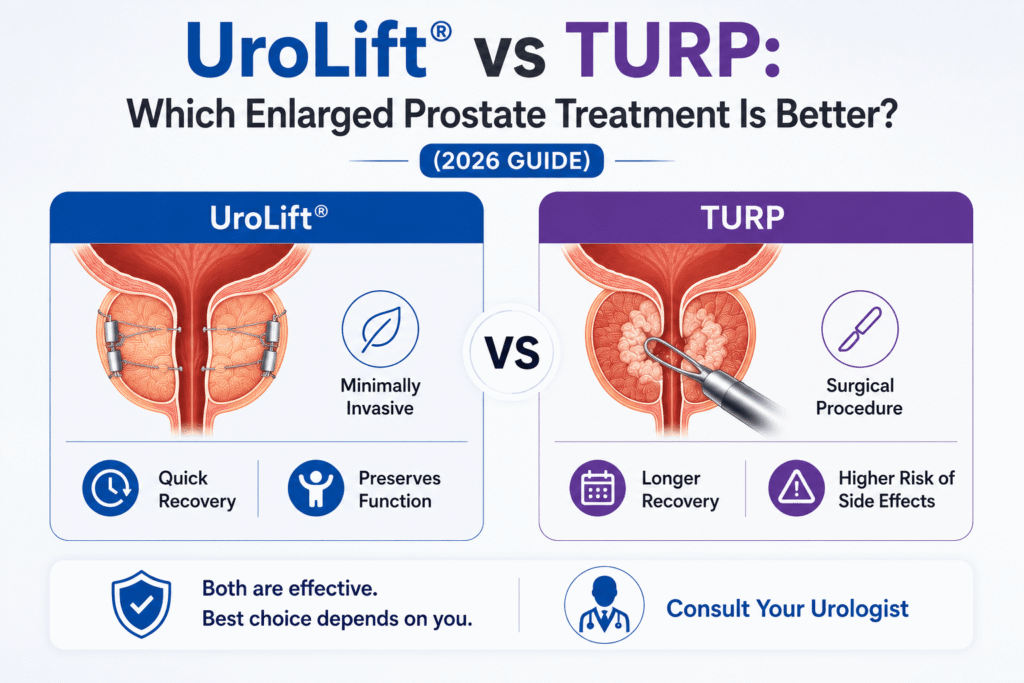
UroLift® and TURP are effective treatments for Benign Prostatic Hyperplasia (BPH), but they differ significantly in how they relieve urinary obstruction. UroLift® is a minimally invasive procedure that uses permanent implants to hold enlarged prostate tissue away from the urethra without removing tissue. TURP (Transurethral Resection of the Prostate) is a surgical procedure that removes obstructing prostate tissue to improve urine flow. The most suitable treatment depends on prostate size, symptom severity, overall health, and individual treatment goals.
Quick Answer
Both UroLift® and TURP are established treatments for enlarged prostate (BPH), but they are designed for different clinical situations.
- UroLift® is a minimally invasive procedure that opens the urethra using small permanent implants without removing prostate tissue.
- TURP is a surgical procedure that removes obstructing prostate tissue through the urethra and has long been considered a standard surgical treatment for BPH.
Neither option is universally better. The most appropriate treatment depends on prostate size, urinary symptoms, anatomy, overall health, and a detailed evaluation by an experienced urologist.
Introduction
When medications no longer provide sufficient relief from enlarged prostate symptoms, many men begin exploring procedural treatment options. Two of the most commonly discussed choices are UroLift® and Transurethral Resection of the Prostate (TURP).
Although both treatments are designed to improve urine flow and reduce urinary symptoms, they differ considerably in their approach, recovery, hospital stay, and suitability for different patients.
This guide compares UroLift® vs TURP to help you understand how each procedure works, who may benefit, expected recovery, potential advantages, limitations, and the factors doctors consider before recommending one treatment over the other.
What Is Benign Prostatic Hyperplasia (BPH)?
Benign Prostatic Hyperplasia (BPH) is a non-cancerous enlargement of the prostate gland that commonly affects men as they age. As the prostate enlarges, it can compress the urethra and interfere with normal urine flow.
Common symptoms include:
- Frequent urination
- Weak urine stream
- Difficulty starting urination
- Urinary urgency
- Interrupted urine flow
- Nocturia (frequent nighttime urination)
- Feeling of incomplete bladder emptying
If left untreated, BPH can lead to urinary retention, recurrent urinary tract infections, bladder stones, and other complications.
Why Compare UroLift® and TURP?
Although both procedures aim to relieve urinary obstruction, they achieve this in different ways.
UroLift® repositions enlarged prostate tissue using permanent implants without removing tissue, while TURP removes excess prostate tissue through the urethra using specialized surgical instruments.
Understanding these differences helps patients choose the treatment that aligns with their medical condition, recovery expectations, and long-term goals.
Similarities Between UroLift® and TURP
Despite their differences, both procedures:
- Treat urinary symptoms caused by BPH
- Improve urine flow
- Are performed by trained urologists
- Aim to improve quality of life
- Require proper patient selection and evaluation
- Are supported by established clinical experience
Major Differences at a Glance
| Feature | UroLift® | TURP |
|---|---|---|
| Treatment Type | Minimally invasive | Surgical |
| Tissue Removal | No | Yes |
| External Incision | No | No |
| Hospital Stay | Usually same day | Often 1–3 days |
| Recovery | Faster | Longer |
| General Anaesthesia | Often not required | Usually required |
| Suitable for Larger Prostates | Selected cases | Commonly considered depending on evaluation |
UroLift® vs TURP: A Detailed Comparison
Both UroLift® and Transurethral Resection of the Prostate (TURP) are established treatments for Benign Prostatic Hyperplasia (BPH). While both procedures are designed to improve urine flow and relieve urinary symptoms caused by an enlarged prostate, they differ significantly in their technique, recovery, suitability, and treatment goals.
Understanding how each procedure works can help patients make informed decisions in consultation with an experienced urologist.
What Is the UroLift® System?
The UroLift® System is a minimally invasive procedure that treats urinary obstruction caused by BPH without removing prostate tissue.
Instead, small permanent implants are placed inside the prostate to gently pull the enlarged tissue away from the urethra, creating a wider channel for urine flow.
Because no tissue is cut, heated, or removed, UroLift has become a popular option for appropriately selected patients seeking a less invasive alternative to surgery.
How Does UroLift® Work?
A specially designed delivery device is inserted through the urethra.
The urologist places tiny implants that compress the enlarged prostate tissue away from the urinary passage.
Once the implants are deployed, the urethra opens immediately, allowing urine to pass more freely.
The procedure is usually completed within an hour and is commonly performed as a day-care procedure.
Who May Be a Suitable Candidate for UroLift®?
UroLift may be considered for patients who:
- Have mild to moderate BPH symptoms
- Have small to medium-sized prostates
- Want a minimally invasive treatment
- Prefer a shorter recovery period
- Wish to avoid tissue removal
Suitability depends on prostate anatomy, symptom severity, and a complete clinical evaluation.
Advantages of UroLift®
Potential benefits include:
- No external incision
- No prostate tissue removal
- Usually performed as a day-care procedure
- Short procedure time
- Faster recovery for many patients
- Early improvement in urine flow
- Lower risk of certain sexual side effects in appropriately selected patients
Limitations of UroLift®
Although UroLift offers many advantages, it may not be appropriate for every patient.
Limitations may include:
- Not suitable for all prostate sizes
- Permanent implants remain in place
- Careful patient selection is essential
- Some patients may require alternative procedures depending on prostate anatomy
Recovery After UroLift®
Recovery is generally quick.
Many patients:
- Return home the same day
- Resume light activities within a few days
- Experience improvement in urinary symptoms relatively soon
- Attend follow-up visits to monitor recovery
Recovery varies depending on individual health and clinical circumstances.
What Is TURP?
Transurethral Resection of the Prostate (TURP) is one of the most established surgical treatments for BPH and has been performed successfully for many decades.
Unlike UroLift, TURP removes the enlarged prostate tissue that is blocking urine flow.
It is often recommended for patients with more significant urinary obstruction or when other treatments are unlikely to provide adequate symptom relief.
How Does TURP Work?
During TURP, a specialized instrument called a resectoscope is inserted through the urethra.
Using an electrical loop, the surgeon carefully removes the obstructing prostate tissue without making any external incision.
Removing this excess tissue widens the urinary channel and improves urine flow.
Who May Be a Suitable Candidate for TURP?
TURP may be recommended for patients who:
- Have moderate to severe urinary symptoms
- Have significant urinary obstruction
- Have not responded adequately to medications
- Experience complications related to BPH
- Require surgical removal of obstructing tissue
Only a qualified urologist can determine whether TURP is the most appropriate option.
Advantages of TURP
Potential benefits include:
- Long-established procedure
- Significant improvement in urinary flow
- Effective symptom relief
- Widely available
- Extensive long-term clinical experience
Limitations of TURP
Some considerations include:
- Requires anesthesia
- Longer recovery compared with minimally invasive procedures
- Usually requires hospital admission
- Temporary catheterization is commonly required
- Recovery may take several weeks
Recovery After TURP
Recovery generally includes:
- Hospital stay of one to three days
- Temporary urinary catheter
- Gradual return to normal activities
- Follow-up appointments to monitor healing
Complete recovery varies depending on the patient’s age, general health, and the amount of tissue removed.
UroLift® vs TURP: Side-by-Side Overview
| Feature | UroLift® | TURP |
|---|---|---|
| Treatment Type | Minimally invasive | Surgical |
| Tissue Removal | No | Yes |
| External Incision | No | No |
| Hospital Stay | Usually same day | Usually 1–3 days |
| Recovery | Faster | Longer |
| Catheter Requirement | Sometimes | Usually required |
| General Anesthesia | Often not required | Usually required |
| Return to Work | Usually within a few days | Often several weeks |
| Suitable for Larger Prostates | Selected patients | Commonly considered based on evaluation |
How Do Doctors Choose Between UroLift® and TURP?
Selecting the right treatment requires a comprehensive evaluation.
Factors commonly considered include:
- Prostate size
- Severity of urinary symptoms
- Bladder function
- Overall health
- Medical history
- Current medications
- Previous prostate treatments
- Lifestyle
- Recovery expectations
- Individual treatment goals
The most appropriate treatment is determined through shared decision-making between the patient and an experienced urologist.
Key Takeaways
- Both UroLift® and TURP are effective treatments for BPH.
- UroLift® uses permanent implants without removing tissue, while TURP surgically removes obstructing prostate tissue.
- UroLift® generally offers faster recovery, whereas TURP has a longer history of use and may be recommended for selected patients with more significant obstruction.
- The choice depends on prostate anatomy, symptom severity, overall health, and patient preferences.
- A consultation with a qualified urologist is essential to determine the most appropriate treatment.
UroLift® vs TURP: Side-by-Side Comparison
Choosing between UroLift® and Transurethral Resection of the Prostate (TURP) involves understanding how each treatment aligns with your symptoms, prostate size, lifestyle, and long-term expectations. While both procedures aim to relieve urinary obstruction caused by Benign Prostatic Hyperplasia (BPH), they differ in technique, recovery, and patient suitability.
The following comparison can help you understand these differences before discussing treatment options with your urologist.
Quick Comparison Table
| Feature | UroLift® | TURP |
|---|---|---|
| Procedure Type | Minimally invasive | Surgical procedure |
| Tissue Removal | No | Yes |
| External Incision | No | No |
| Hospital Stay | Usually same day | Usually 1–3 days |
| General Anesthesia | Often not required | Usually required |
| Recovery Time | Faster | Longer |
| Catheter Requirement | Sometimes | Commonly required |
| Return to Daily Activities | Usually within a few days | Usually several weeks |
| Suitable for Larger Prostates | Selected patients | Often considered for moderate to larger prostates after evaluation |
| Long-Term Follow-up | Required | Required |
Procedure Duration
Both treatments are performed through the urethra without external cuts.
UroLift®
- Usually completed within an hour.
- Patients often return home the same day.
TURP
- Usually takes between one and two hours, depending on the amount of tissue removed.
- Hospital admission is commonly required.
The exact procedure time depends on prostate anatomy and the complexity of the case.
Recovery Time
Recovery is an important factor when choosing between these treatments.
Recovery After UroLift®
Many patients:
- Return home on the same day
- Resume light daily activities within a few days
- Notice improvement in urine flow relatively quickly
- Experience minimal interruption to normal routines
Recovery After TURP
Recovery generally includes:
- Hospital stay
- Temporary urinary catheter
- Several weeks before full recovery
- Follow-up appointments to monitor healing
The recovery timeline varies according to age, overall health, and the extent of the procedure.
Hospital Stay
UroLift®
Usually performed as a day-care procedure, allowing many patients to return home the same day.
TURP
Hospital admission is commonly required, and patients may stay for one or more days depending on recovery.
Catheter Requirement
UroLift®
Some patients may not require a catheter, while others may need temporary catheterization depending on their individual condition.
TURP
A urinary catheter is commonly placed after surgery to support healing and is typically removed after a short period.
Effectiveness
Both treatments aim to relieve urinary symptoms caused by enlarged prostate.
Patients often experience improvement in:
- Weak urine stream
- Frequent urination
- Nighttime urination (nocturia)
- Urinary urgency
- Difficulty starting urination
- Incomplete bladder emptying
The degree of improvement depends on:
- Prostate size
- Bladder function
- Symptom severity
- Overall health
- Individual healing response
Which Treatment Offers Faster Recovery?
For many patients, UroLift® allows a quicker return to normal daily activities because it does not involve removing prostate tissue.
TURP, being a surgical procedure, generally requires a longer healing period before patients can resume strenuous activities.
However, recovery experiences vary from person to person.
Which Treatment Is Better for Younger Men?
Younger men often consider:
- Recovery time
- Return to work
- Lifestyle
- Long-term quality of life
- Preservation of sexual function
Depending on the individual’s clinical evaluation, either procedure may be appropriate.
Treatment recommendations should always be based on medical assessment rather than age alone.
Which Treatment Is Better for Older Adults?
Older patients may have additional health considerations, including:
- Diabetes
- Heart disease
- High blood pressure
- Kidney disease
- Blood-thinning medications
These factors influence treatment selection.
A comprehensive evaluation helps determine whether UroLift®, TURP, or another BPH treatment is the most appropriate option.
Which Treatment Is More Suitable for Larger Prostates?
Prostate size plays an important role in treatment planning.
While UroLift® may be appropriate for selected patients with certain prostate sizes and anatomy, TURP is commonly considered for patients with more significant urinary obstruction after careful evaluation.
Your urologist will determine the most suitable treatment based on imaging studies and clinical findings.
Long-Term Symptom Relief
Both treatments can provide durable improvement when patients are appropriately selected.
Long-term outcomes depend on:
- Accurate diagnosis
- Appropriate patient selection
- Surgical expertise
- Follow-up care
- Lifestyle modifications
- Management of other health conditions
Regular follow-up remains important regardless of the treatment chosen.
Cost Considerations
Treatment costs vary depending on:
- Hospital
- City
- Surgeon’s experience
- Technology used
- Hospital stay
- Insurance coverage
- Diagnostic investigations
Patients should prioritize the treatment that is medically appropriate rather than making a decision based solely on cost.
Questions to Ask Your Urologist
Before deciding between UroLift® and TURP, ask your doctor:
- Am I a suitable candidate for UroLift®?
- Is TURP recommended for my prostate size?
- What results can I realistically expect?
- Will I require a catheter?
- How long will recovery take?
- When can I return to work?
- What follow-up care is required?
- Are there alternative treatments that may be more suitable?
Expert Opinion
Both UroLift® and TURP are well-established treatments for Benign Prostatic Hyperplasia. Neither procedure is universally better.
The ideal treatment depends on prostate anatomy, urinary symptoms, medical history, lifestyle, and patient expectations. An experienced urologist can recommend the most appropriate option after a thorough clinical evaluation.
Key Takeaways
- UroLift® and TURP are effective treatments for enlarged prostate.
- UroLift® is minimally invasive and generally offers faster recovery.
- TURP is a surgical procedure with a long history of providing effective symptom relief.
- Treatment selection depends on prostate size, symptom severity, overall health, and individual treatment goals.
- A personalized consultation with an experienced urologist is the best way to determine the most appropriate treatment.
Frequently Asked Questions (FAQs)
1. Which is better, UroLift® or TURP?
There is no single treatment that is best for every patient. UroLift® and TURP are both effective treatments for Benign Prostatic Hyperplasia (BPH), but the most appropriate option depends on prostate size, urinary symptoms, overall health, prostate anatomy, and individual treatment goals.
2. What is the main difference between UroLift® and TURP?
UroLift® is a minimally invasive procedure that uses permanent implants to hold enlarged prostate tissue away from the urethra without removing tissue. TURP is a surgical procedure that removes obstructing prostate tissue through the urethra to improve urine flow.
3. Which procedure offers faster recovery?
Many patients recover more quickly after UroLift® because it does not involve tissue removal. TURP generally requires a longer recovery period due to surgical tissue removal and hospital admission.
4. Is UroLift® less invasive than TURP?
Yes. UroLift® is considered a minimally invasive treatment and is commonly performed as a day-care procedure. TURP is a surgical treatment that usually requires anesthesia, temporary catheterization, and a short hospital stay.
5. Which treatment provides better long-term symptom relief?
Both procedures can provide durable symptom relief when patients are appropriately selected. Long-term outcomes depend on prostate size, symptom severity, overall health, and regular follow-up with a urologist.
6. Will I need a urinary catheter after treatment?
Some patients undergoing UroLift® may not require a catheter, while temporary catheterization is commonly used after TURP during the initial recovery period.
7. Which treatment is suitable for larger prostates?
Treatment selection depends on prostate size and anatomy. TURP is commonly considered for patients with moderate to larger prostates after specialist evaluation, while UroLift® may be suitable for selected patients depending on individual clinical findings.
8. Can both procedures improve urinary symptoms?
Yes. Both UroLift® and TURP are designed to relieve symptoms such as weak urine stream, frequent urination, urgency, nighttime urination, and incomplete bladder emptying caused by BPH.
9. Are both procedures performed without external incisions?
Yes. Both UroLift® and TURP are performed through the urethra and do not require external surgical incisions.
10. Which procedure allows a quicker return to work?
Many patients undergoing UroLift® return to routine activities sooner than those undergoing TURP. The exact recovery period varies depending on individual health and the type of work performed.
11. How do doctors decide between UroLift® and TURP?
Doctors consider several factors, including:
- Prostate size
- Urinary symptoms
- Bladder function
- Medical history
- Current medications
- Overall health
- Lifestyle
- Personal treatment goals
A comprehensive assessment helps determine the most appropriate treatment.
12. Should I choose UroLift® or TURP based only on cost?
No. Treatment decisions should be based primarily on medical suitability, expected outcomes, and expert clinical advice rather than cost alone.
Conclusion
Both UroLift® and Transurethral Resection of the Prostate (TURP) are effective treatment options for men with Benign Prostatic Hyperplasia (BPH). While both procedures improve urinary symptoms, they differ in how they work, recovery time, hospital stay, and patient suitability.
UroLift® offers a minimally invasive approach without removing prostate tissue, making it an attractive option for appropriately selected patients seeking a quicker recovery. TURP remains one of the most established surgical treatments for BPH and may be recommended for patients with more significant urinary obstruction or larger prostates.
Rather than asking which treatment is universally better, patients should focus on identifying the option that best matches their prostate size, symptoms, overall health, and personal preferences. A detailed consultation with an experienced urologist is the best way to determine the most suitable treatment plan.
Unsure Whether UroLift® or TURP Is Right for You?
Choosing the right treatment for an enlarged prostate requires more than comparing procedures—it requires expert medical evaluation.
Dr. Priyaddarshi Ranjan specializes in advanced BPH treatments and can help determine whether UroLift®, TURP, Rezūm Therapy, Laser Prostate Surgery, Aquablation Therapy, iTind, or PAE is the most appropriate option based on your symptoms, prostate size, and overall health.