Best Treatment for Enlarged Prostate Without Surgery is one of the most searched topics by men diagnosed with Benign Prostatic Hyperplasia (BPH). Many patients want effective relief from urinary symptoms without undergoing traditional surgery, worrying about long recovery times, hospital stays, and possible side effects affecting sexual function.
The good news is that not every enlarged prostate requires surgery. Today, several non-surgical and minimally invasive treatments can effectively relieve BPH symptoms while offering faster recovery and, in many cases, preserving sexual function.
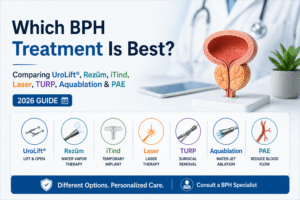
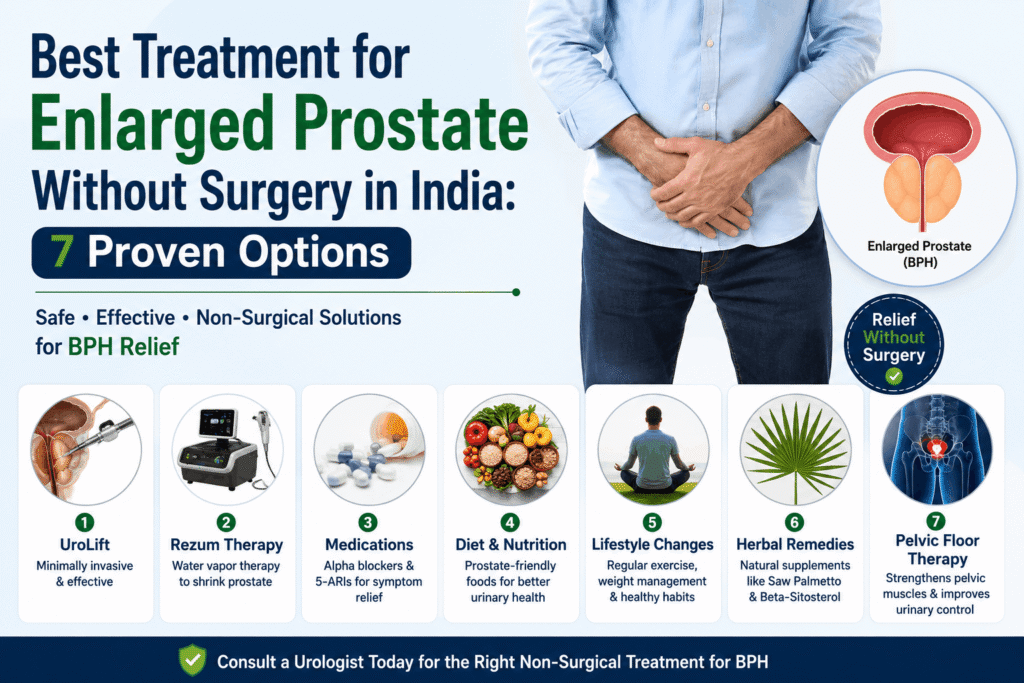
Treatment options such as UroLift®, Rezūm™ Water Vapor Therapy, iTind, Prostatic Artery Embolisation (PAE), medications, and lifestyle modifications have transformed the way BPH is managed. The best treatment depends on factors such as prostate size, symptom severity, overall health, age, and individual treatment goals.
This comprehensive guide explains the best non-surgical treatments for enlarged prostate, compares their benefits, recovery times, effectiveness, and helps you understand which option may be right for you.
What is the best treatment for enlarged prostate without surgery?
The best treatment depends on your symptoms and prostate size. For many men with mild to moderate BPH, UroLift, Rezūm, iTind, and Prostatic Artery Embolisation (PAE) provide effective symptom relief without traditional surgery. Lifestyle changes and medications may also help in early stages, while larger prostates or severe obstruction may require surgical treatment if minimally invasive procedures are not suitable.
What Is an Enlarged Prostate (BPH)?
Benign Prostatic Hyperplasia (BPH) is a non-cancerous enlargement of the prostate gland that commonly develops as men age.
The prostate surrounds the urethra, the tube that carries urine from the bladder. As the prostate grows, it can compress the urethra, making it difficult for urine to flow normally.
Unlike prostate cancer, BPH is not cancerous and does not increase your risk of developing prostate cancer. However, untreated BPH can significantly affect your quality of life and may lead to complications such as urinary retention, bladder stones, recurrent urinary tract infections, or kidney damage.
Common Symptoms of an Enlarged Prostate
Men with BPH may experience:
- Frequent urination
- Sudden urge to urinate
- Weak urine stream
- Difficulty starting urination
- Interrupted urine flow
- Dribbling after urination
- Feeling that the bladder is not completely empty
- Waking up multiple times at night to urinate (nocturia)
- Urinary retention in severe cases
If these symptoms begin interfering with your daily activities or sleep, it is important to consult a urologist for evaluation.
Do All Men with BPH Need Surgery?
No.
Many men believe surgery is the only solution for an enlarged prostate, but this is no longer true.
Most patients can initially be managed with:
- Lifestyle changes
- Medications
- Minimally invasive procedures
- Regular monitoring
Traditional surgery is generally reserved for men with:
- Very large prostates
- Recurrent urinary retention
- Bladder stones
- Kidney damage caused by obstruction
- Recurrent urinary tract infections
- Failure of conservative treatment
Advances in medical technology now allow many men to avoid traditional surgery while still achieving significant symptom relief.
Why Many Patients Prefer Non-Surgical BPH Treatment
Modern non-surgical treatments have become increasingly popular because they offer several advantages over conventional surgery.
Benefits include:
- No major surgical incision
- Shorter recovery time
- Lower risk of bleeding
- Less postoperative pain
- Short hospital stay or same-day discharge
- Faster return to work
- Lower anesthesia requirements for many procedures
- Better preservation of erectile function in appropriate patients
- Lower overall disruption to daily life
For many men, these benefits make minimally invasive therapies an attractive first-line option.
Who Is a Good Candidate for Non-Surgical Treatment?
You may be a suitable candidate if you:
- Have mild to moderate urinary symptoms
- Want to avoid traditional surgery
- Prefer a faster recovery
- Wish to preserve sexual function when possible
- Have not responded adequately to medications
- Are medically fit for minimally invasive procedures
The most appropriate treatment should always be determined after a detailed consultation with a qualified urologist.
Factors That Determine the Best Treatment
There is no single treatment that is best for every patient.
Your urologist will consider several factors before recommending a treatment plan.
1. Prostate Size
Smaller prostates may respond well to medications or procedures such as UroLift or iTind, while larger prostates may require other minimally invasive techniques or surgery.
2. Severity of Symptoms
Doctors often assess symptom severity using the International Prostate Symptom Score (IPSS).
Treatment recommendations differ for:
- Mild symptoms
- Moderate symptoms
- Severe symptoms
3. Age
Younger patients often prioritize preserving ejaculation and erectile function, while older patients may focus primarily on symptom relief and long-term outcomes.
4. Overall Health
Medical conditions such as:
- Diabetes
- Heart disease
- High blood pressure
- Bleeding disorders
may influence which treatments are safest and most appropriate.
5. Sexual Function Goals
Many men are concerned about maintaining:
- Erectile function
- Ejaculation
- Fertility
- Overall sexual satisfaction
Modern treatments like UroLift, Rezūm, iTind, and PAE are often selected when preserving sexual function is an important priority.
6. Personal Preferences
Some patients prefer:
- Avoiding anesthesia
- Outpatient treatment
- Minimal downtime
- No permanent implants
- Long-term symptom relief
Discussing these preferences with your urologist helps tailor the treatment plan to your individual needs.
Can Lifestyle Changes Help?
Lifestyle modifications can significantly improve mild BPH symptoms and may complement medical or minimally invasive treatment.
Helpful lifestyle strategies include:
- Maintaining a healthy weight
- Exercising regularly
- Limiting caffeine
- Reducing alcohol intake
- Avoiding excessive evening fluids
- Managing constipation
- Practicing timed voiding
- Controlling diabetes and high blood pressure
- Stopping smoking
Although lifestyle changes alone may not eliminate BPH, they often improve urinary comfort and overall bladder health.
Can Lifestyle Changes Help?
Lifestyle modifications can significantly improve mild BPH symptoms and may complement medical or minimally invasive treatment.
Helpful lifestyle strategies include:
- Maintaining a healthy weight
- Exercising regularly
- Limiting caffeine
- Reducing alcohol intake
- Avoiding excessive evening fluids
- Managing constipation
- Practicing timed voiding
- Controlling diabetes and high blood pressure
- Stopping smoking
Although lifestyle changes alone may not eliminate BPH, they often improve urinary comfort and overall bladder health.
When Should You Consider Advanced Treatment?
You should consider minimally invasive treatment if:
- Medications no longer provide adequate relief.
- Side effects from medication affect your quality of life.
- Urinary symptoms interfere with work, travel, or sleep.
- You experience repeated urinary retention.
- Your symptoms continue to worsen despite conservative management.
- Your urologist identifies bladder or kidney complications related to BPH.
Early intervention can prevent complications and improve long-term quality of life.
Key Takeaways
- The Best Treatment for an enlarged prostate without surgery depends on prostate size, symptoms, overall health, and personal goals.
- Many men can successfully avoid traditional surgery through medications, lifestyle changes, or minimally invasive procedures.
- UroLift, Rezūm, iTind, and PAE have expanded treatment options for patients seeking effective relief with shorter recovery times.
- Early evaluation by a urologist helps determine the most appropriate treatment before complications develop.
- Choosing the right treatment requires a personalized assessment rather than a one-size-fits-all approach.
1. Lifestyle Changes for Mild BPH
For men with mild symptoms, lifestyle modifications are often the first step in treatment. While they may not reduce the size of the prostate, they can help improve urinary symptoms and slow disease progression.
Recommended Lifestyle Changes
- Maintain a healthy weight
- Exercise regularly (30–45 minutes most days)
- Reduce caffeine intake
- Limit alcohol consumption
- Drink adequate water during the day but avoid excessive fluids before bedtime
- Eat a prostate-friendly diet rich in fruits, vegetables, and whole grains
- Quit smoking
- Control diabetes and high blood pressure
Best For
- Mild BPH symptoms
- Recently diagnosed patients
- Men who want to delay medication or procedures
Pros
- No side effects
- Improves overall health
- Supports bladder function
Cons
- Does not shrink the prostate
- May not be enough for moderate or severe symptoms
2. Medications for Enlarged Prostate
Medications are commonly prescribed for men with mild to moderate BPH who are not yet candidates for procedures.
There are two main types:
Alpha-Blockers
Examples:
- Tamsulosin
- Alfuzosin
- Silodosin
- Doxazosin
How They Work
These medications relax the muscles around the prostate and bladder neck, making it easier to urinate.
Benefits
- Fast symptom relief
- Improves urine flow
- Usually works within days
Limitations
- Does not reduce prostate size
- Symptoms may return if medication is stopped
- May cause dizziness or ejaculation changes
5-Alpha Reductase Inhibitors
Examples:
- Finasteride
- Dutasteride
How They Work
These medicines reduce prostate size by lowering DHT (dihydrotestosterone) levels.
Benefits
- Shrinks enlarged prostate
- Reduces the risk of urinary retention
- Lowers the chance of needing surgery
Limitations
- Takes several months to show results
- May reduce libido
- May cause erectile dysfunction in some men
3. UroLift® System
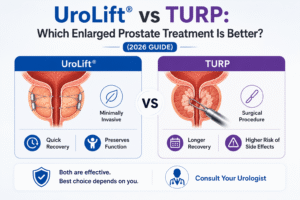
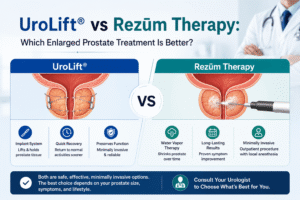
The UroLift System is one of the most popular minimally invasive treatments for enlarged prostate.
Instead of removing prostate tissue, tiny permanent implants are used to lift and hold enlarged prostate tissue away from the urethra.
How It Works
Small implants are placed through a cystoscope to create an open urinary channel.
Advantages
- No cutting or removal of tissue
- Usually preserves erectile function
- Usually preserves ejaculation
- No catheter for many patients
- Same-day discharge
- Quick recovery
- Immediate symptom improvement for many men
Recovery
- Return to normal activities in a few days
- Temporary burning during urination may occur
- Mild blood in urine for a short period
Best For
- Mild to moderate BPH
- Men who want to preserve sexual function
- Patients seeking a fast recovery
4. Rezūm™ Water Vapor Therapy
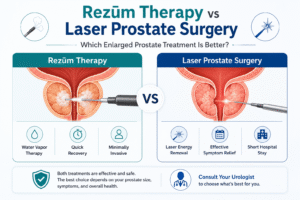
Rezūm uses controlled water vapor (steam) to destroy excess prostate tissue.
Over several weeks, the treated tissue is naturally absorbed by the body, opening the urinary passage.
Advantages
- No surgical incision
- Outpatient procedure
- Preserves erectile function in most men
- Usually maintains ejaculation
- Durable symptom relief
Recovery
- Temporary catheter for some patients
- Improvement usually occurs within several weeks
- Mild urinary irritation during healing
Best For
- Moderate BPH
- Men wanting to avoid traditional surgery
- Patients seeking long-term symptom relief
5. iTind Procedure
The Temporarily Implanted Nitinol Device (iTind) reshapes the prostate opening without removing tissue.
Unlike permanent implants, the device is removed after several days.
Advantages
- No permanent implant
- No tissue removal
- Preserves sexual function
- Outpatient procedure
- Fast recovery
Recovery
- Device removed after approximately 5–7 days
- Mild urinary discomfort during treatment
- Rapid return to daily activities
Best For
- Mild to moderate BPH
- Younger men
- Patients preferring a temporary device
6. Prostatic Artery Embolisation (PAE)
PAE is performed by an interventional radiologist rather than a traditional surgeon.
Tiny particles are injected into the arteries supplying the prostate, reducing blood flow and causing the gland to shrink over time.
Advantages
- No surgical incision
- Local anesthesia
- Minimal bleeding
- Short hospital stay
- Usually preserves erectile function
- Suitable for selected patients with larger prostates
Recovery
- Most patients return home the same day or the next day
- Mild pelvic discomfort for a few days
- Gradual improvement over several weeks
Best For
- Patients at higher surgical risk
- Larger prostates
- Men wishing to avoid conventional surgery
Comparison of Non-Surgical Enlarged Prostate Treatments
| Treatment | Procedure Type | Preserves Erections | Preserves Ejaculation | Hospital Stay | Recovery |
|---|---|---|---|---|---|
| Lifestyle Changes | Conservative | ✅ Yes | ✅ Yes | None | Immediate |
| Medications | Medical | Usually | May Vary | None | Ongoing |
| UroLift | Minimally Invasive | ✅ Yes | ✅ Usually | Same Day | Few Days |
| Rezūm | Water Vapor Therapy | ✅ Usually | ✅ Usually | Same Day | 2–6 Weeks |
| iTind | Temporary Device | ✅ Yes | ✅ Yes | Same Day | Few Days |
| PAE | Image-Guided Procedure | ✅ Usually | ✅ Usually | Same Day | 1–2 Weeks |
Which Non-Surgical Treatment Is Best?
There is no single treatment that is ideal for every patient.
Generally:
Choose Lifestyle Changes If:
- Symptoms are mild.
- You want to avoid medications initially.
Choose Medications If:
- Symptoms are moderate.
- You are not yet ready for a procedure.
- You need temporary symptom relief.
Choose UroLift If:
- Preserving sexual function is your top priority.
- You want rapid recovery.
- Your prostate anatomy is suitable.
Choose Rezūm If:
- You want long-term symptom improvement.
- You prefer avoiding permanent implants.
- You can wait several weeks for full results.
Choose iTind If:
- You want a temporary implant.
- You prefer no tissue removal.
- You have mild to moderate enlargement.
Choose PAE If:
- You have a larger prostate.
- You wish to avoid surgery.
- You are a suitable candidate based on vascular anatomy.
Why Expert Evaluation Is Essential
Choosing the wrong treatment may lead to:
- Persistent urinary symptoms
- Unnecessary side effects
- Repeat procedures
- Delayed recovery
A comprehensive evaluation typically includes:
- Medical history
- Digital Rectal Examination (DRE)
- PSA test
- Ultrasound
- Uroflowmetry
- Post-Void Residual (PVR) measurement
- IPSS symptom scoring
These tests help determine which treatment offers the best balance of effectiveness, recovery, and preservation of sexual function.
Key Takeaways
- Lifestyle changes and medications remain effective for many men with mild to moderate BPH.
- UroLift, Rezūm, iTind, and PAE provide minimally invasive alternatives to traditional surgery.
- Each treatment has different advantages, recovery times, and suitability based on prostate size and symptom severity.
- The best treatment should always be selected after a detailed assessment by an experienced urologist.
When Is Surgery Still Necessary for an Enlarged Prostate?
Although many men can successfully manage Benign Prostatic Hyperplasia (BPH) with medications or minimally invasive procedures, surgery may still be the best option for certain patients.
Your urologist may recommend surgery if you have:
- Severe urinary obstruction
- Recurrent urinary retention
- Bladder stones
- Repeated urinary tract infections (UTIs)
- Blood in the urine due to BPH
- Kidney damage caused by long-term obstruction
- Failure of medications or minimally invasive treatments
- A very large prostate that is not suitable for non-surgical procedures
The goal is always to choose the least invasive treatment that provides long-lasting symptom relief while minimizing complications.
7. Laser Prostate Surgery
Laser Prostate Surgery is one of the most advanced surgical treatments for moderate to severe BPH.
Instead of using an electrical loop, a high-energy laser removes or vaporizes excess prostate tissue blocking the urethra.
Types of Laser Surgery
- Holmium Laser Enucleation of the Prostate (HoLEP)
- GreenLight Laser Therapy
- Thulium Laser Enucleation (ThuLEP)
Advantages
- Excellent urine flow improvement
- Less bleeding than TURP
- Suitable for patients taking blood thinners
- Short hospital stay
- Faster recovery
- Durable long-term results
Possible Side Effects
Like any medical procedure, laser surgery may have risks, including:
- Temporary burning during urination
- Blood in urine
- Urinary urgency during healing
- Retrograde ejaculation
- Temporary urinary incontinence (rare)
Most men retain erectile function after laser prostate surgery.
Recovery
- Hospital stay: 1 day
- Catheter: Usually 1 day
- Return to work: 1–2 weeks
- Full recovery: 3–6 weeks
TURP (Transurethral Resection of the Prostate)
For decades, TURP has been considered the gold standard surgical treatment for enlarged prostate.
During TURP, the surgeon removes excess prostate tissue through the urethra using a specialized instrument called a resectoscope.
Benefits
- Excellent long-term symptom relief
- Significant improvement in urine flow
- Proven success over many years
- Widely available
Limitations
Although highly effective, TURP is more invasive than minimally invasive treatments.
Possible side effects include:
- Bleeding
- Infection
- Temporary catheter
- Retrograde ejaculation
- Rare urinary incontinence
Most men continue to have normal erectile function after TURP.
Recovery
- Hospital stay: 1–2 days
- Catheter: 1–3 days
- Return to work: 2–4 weeks
- Full recovery: 6–8 weeks
Aquablation Therapy
Aquablation is a modern robotic treatment that removes excess prostate tissue using a high-pressure water jet guided by real-time ultrasound imaging.
Unlike laser surgery or TURP, no heat is used during tissue removal.
Benefits
- High precision
- Effective for larger prostates
- Lower risk of damage to surrounding tissues
- Better preservation of ejaculation in selected patients
- Excellent urinary symptom improvement
Recovery
- Hospital stay: Usually overnight
- Catheter: 1–2 days
- Return to normal activity: 2–3 weeks
Which Treatment Has the Fastest Recovery?
| Treatment | Recovery Time |
|---|---|
| Lifestyle Changes | Immediate |
| Medications | Ongoing |
| UroLift | 2–7 days |
| iTind | About 1 week |
| PAE | 1–2 weeks |
| Rezūm | 2–6 weeks |
| Laser Surgery | 3–6 weeks |
| Aquablation | 2–4 weeks |
| TURP | 6–8 weeks |
For men seeking minimal downtime, UroLift, iTind, and PAE often offer the quickest recovery.
Which Treatment Has the Highest Success Rate?
Every treatment has strengths depending on prostate size, anatomy, and symptom severity.
Lifestyle Changes
- Helpful for mild symptoms
- Best when combined with healthy habits
Medications
- Effective for mild to moderate BPH
- Symptoms may return after stopping medication
UroLift
- Excellent symptom relief
- Rapid recovery
- High patient satisfaction
- Preserves sexual function in most suitable patients
Rezūm
- Long-lasting improvement
- Significant symptom reduction
- Good preservation of erectile function
iTind
- Effective for selected patients
- Quick recovery
- No permanent implant
PAE
- Good symptom improvement
- Especially useful for selected men with larger prostates
- Minimally invasive
Laser Surgery
- Excellent long-term results
- Effective for larger prostates
- Lower bleeding risk
TURP
- Proven long-term durability
- Excellent urine flow improvement
- Ideal for severe obstruction
Aquablation
- Excellent clinical outcomes
- Precise tissue removal
- Lower risk of sexual side effects in appropriate candidates
Enlarged Prostate Treatment Cost in India
The cost of treatment varies depending on several factors, including:
- Type of treatment
- Hospital
- City
- Surgeon’s experience
- Room category
- Insurance coverage
- Complexity of the procedure
Because costs differ widely across hospitals and regions, it is best to request a personalized estimate after consultation rather than relying on fixed online figures.
Which Treatment Is Best for Preserving Sexual Function?
Many patients worry about erections and ejaculation when choosing treatment.
Generally, the following options are preferred for men prioritizing sexual function:
- UroLift
- Rezūm
- iTind
- PAE
Traditional surgeries such as TURP and Laser Prostate Surgery are highly effective but may have a higher likelihood of affecting ejaculation, even though erectile function is usually preserved.
How to Choose the Best Treatment for Enlarged Prostate Without Surgery
There is no universal “best” treatment.
The right option depends on:
Your Age
Younger men often prioritize preserving ejaculation and erectile function.
Prostate Size
Some procedures are better suited for smaller prostates, while others are designed for larger glands.
Symptom Severity
Treatment should match how much BPH affects your daily activities and quality of life
Medical Conditions
Diabetes, heart disease, bleeding disorders, and other health issues may influence which treatments are safest.
Personal Preferences
Some patients prefer:
- No permanent implants
- No surgery
- Fast recovery
- Local anesthesia
- Long-term symptom relief
Discussing these goals with your urologist helps determine the most appropriate treatment.
Questions to Ask Your Urologist
Before deciding on treatment, consider asking:
- What is causing my urinary symptoms?
- How large is my prostate?
- Am I a candidate for minimally invasive treatment?
- Which treatment is likely to preserve sexual function?
- How long will recovery take?
- What are the possible risks and complications?
- Will I need future treatment?
- How experienced are you with this procedure?
These questions can help you make an informed decision.
Expert Recommendations
Current evidence suggests that treatment should be individualized rather than based on a one-size-fits-all approach.
Many men with mild to moderate BPH benefit from minimally invasive procedures such as UroLift, Rezūm, iTind, or PAE, while those with larger prostates or severe obstruction may achieve better outcomes with Laser Prostate Surgery, TURP, or Aquablation.
The most suitable treatment should always be chosen after a detailed clinical evaluation, imaging, and discussion of your priorities, including recovery time and preservation of sexual function.
Key Takeaways
- Surgery is not necessary for every man with BPH.
- Several minimally invasive treatments provide effective relief with shorter recovery times.
- Laser Surgery, TURP, and Aquablation remain valuable options for larger prostates or advanced disease.
- Recovery time, prostate size, sexual function goals, and overall health all influence treatment selection.
- A personalized evaluation by an experienced urologist is the best way to identify the most appropriate treatment.
Frequently Asked Questions (FAQs)
1. What is the best treatment for enlarged prostate without surgery?
The best treatment depends on your prostate size, symptoms, age, and overall health. For many men with mild to moderate BPH, minimally invasive treatments such as UroLift®, Rezūm™, iTind, and Prostatic Artery Embolisation (PAE) provide effective symptom relief while avoiding traditional surgery.
2. Can an enlarged prostate be treated without surgery?
Yes. Many men can successfully manage BPH with lifestyle changes, medications, or minimally invasive procedures. Surgery is generally reserved for severe cases or when complications develop.
3. Which non-surgical BPH treatment has the fastest recovery?
UroLift and iTind generally offer some of the shortest recovery times, with many patients returning to normal activities within a few days. Recovery varies depending on the individual and the chosen treatment.
4. Which enlarged prostate treatment preserves sexual function?
UroLift, Rezūm, iTind, and PAE are commonly selected for suitable patients because they are designed to preserve erectile function. Individual outcomes may vary, so discuss expectations with your urologist.
5. Is medication enough to treat BPH?
For men with mild symptoms, medications may provide good relief. However, they do not cure BPH, and symptoms can return if treatment is stopped. Some patients eventually require minimally invasive procedures or surgery.
6. Is UroLift better than TURP?
Neither treatment is universally better. UroLift offers faster recovery and better preservation of sexual function for suitable candidates, while TURP remains highly effective for men with more severe obstruction or larger prostates.
7. Is Rezūm a permanent treatment?
Rezūm provides long-lasting symptom relief for many men by shrinking excess prostate tissue. Regular follow-up is still important to monitor prostate health over time.
8. What is the recovery time after non-surgical BPH treatment?
Recovery depends on the procedure:
- UroLift: 2–7 days
- iTind: Around 1 week
- PAE: 1–2 weeks
- Rezūm: 2–6 weeks
Your urologist will provide personalized recovery guidance.
9. Which treatment is best for a large prostate?
Men with larger prostates may benefit from PAE, Laser Prostate Surgery, Aquablation Therapy, or other advanced procedures, depending on their anatomy and overall health.
10. When should I consider surgery for an enlarged prostate?
Surgery may be recommended if you have severe urinary obstruction, repeated urinary retention, bladder stones, recurrent infections, kidney damage, or if conservative treatments no longer provide adequate relief.
11. Can lifestyle changes improve BPH symptoms?
Yes. Regular exercise, maintaining a healthy weight, limiting caffeine and alcohol, quitting smoking, and managing chronic conditions can help improve urinary symptoms and support overall prostate health.
12. How do I know which BPH treatment is right for me?
The best treatment depends on your prostate size, symptom severity, medical history, sexual health goals, and personal preferences. A detailed evaluation by an experienced urologist is essential to determine the most suitable option.
Conclusion
Finding the Best Treatment for Enlarged Prostate Without Surgery starts with understanding your symptoms, prostate size, and long-term health goals. Fortunately, many men no longer need traditional surgery to achieve lasting relief from BPH symptoms.
Modern treatment options such as UroLift®, Rezūm™, iTind, and Prostatic Artery Embolisation (PAE) have transformed BPH care by providing effective symptom relief with shorter recovery times and a strong focus on preserving quality of life.
However, no single treatment is ideal for everyone. Some patients benefit from medications and lifestyle changes, while others achieve better outcomes with minimally invasive procedures or surgery.
The best approach is to consult an experienced urologist who can recommend a personalized treatment plan based on your individual needs, helping you regain comfortable urination and improve your overall quality of life.
Looking for the Best Treatment for Enlarged Prostate Without Surgery?
If you are experiencing frequent urination, weak urine flow, or other BPH symptoms, don’t wait for the condition to worsen. Schedule a consultation with Dr. Priyaddarshi Ranjan, an experienced urologist specializing in advanced BPH treatments.
After a detailed evaluation, you’ll receive a personalized treatment plan that may include medications, UroLift®, Rezūm™, iTind, PAE, or other advanced therapies based on your prostate size, symptoms, and treatment goals.
Take the first step toward better urinary health and improved quality of life today.