
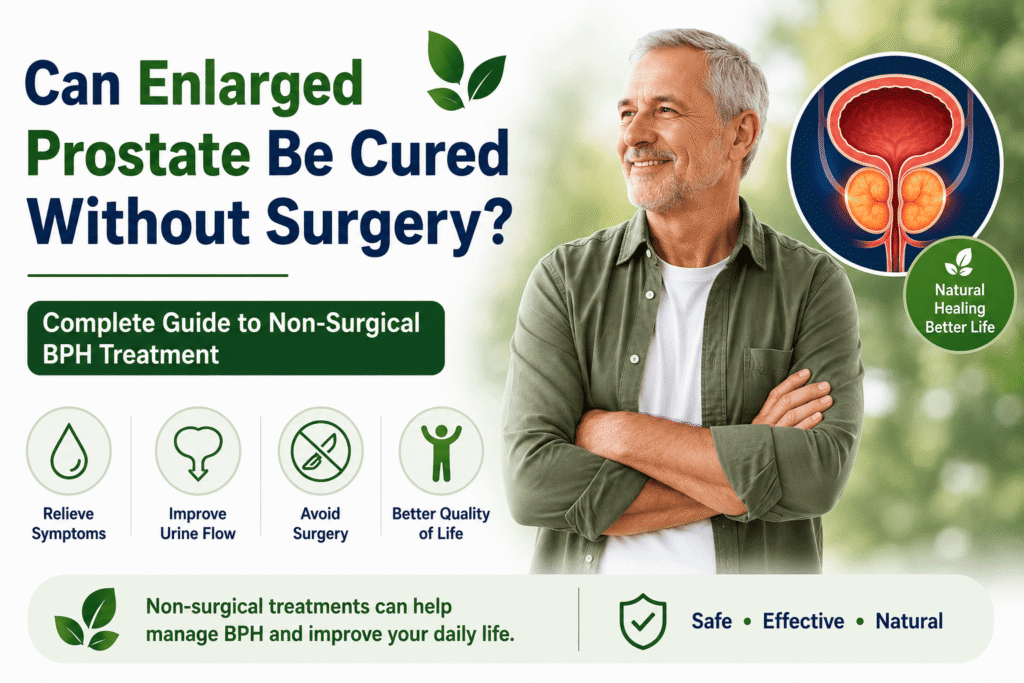
Can enlarged prostate be cured without surgery? This is one of the most common questions men ask after being diagnosed with Benign Prostatic Hyperplasia (BPH). Many people worry that surgery is the only solution for an enlarged prostate, but the good news is that this is not always the case.
Today, many men with mild to moderate BPH can successfully manage their symptoms through lifestyle changes, medications, and advanced minimally invasive procedures that do not require traditional surgery. The best treatment depends on several factors, including the size of the prostate, the severity of symptoms, overall health, and personal preferences.
If left untreated, BPH can lead to worsening urinary symptoms, bladder damage, urinary tract infections, bladder stones, or even kidney problems. Seeking timely medical advice can help prevent complications and improve your quality of life.
In this comprehensive guide, you’ll learn whether an enlarged prostate can be treated without surgery, the available non-surgical treatment options, lifestyle modifications, and when surgery may become necessary.
Can enlarged prostate be cured without surgery? The answer depends on the severity of your symptoms, prostate size, and overall health. Fortunately, many men can successfully manage BPH without traditional surgery.
Quick Answer
Yes, an enlarged prostate can often be treated without surgery, especially in the early and moderate stages of Benign Prostatic Hyperplasia (BPH).
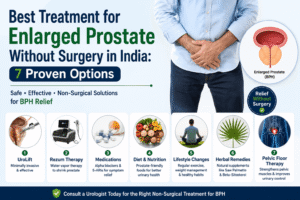
Depending on your symptoms and prostate size, your doctor may recommend:
- Lifestyle changes
- Dietary modifications
- Regular exercise
- Medications
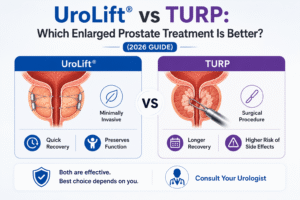
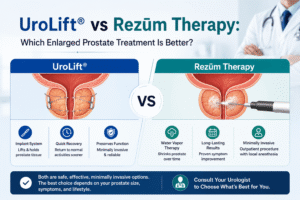
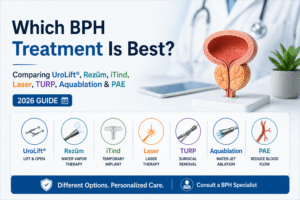
- UroLift® System
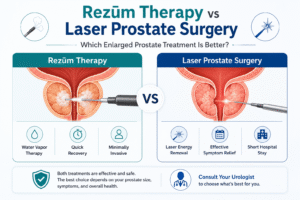
- Rezūm™ Water Vapor Therapy
- iTind Procedure
- Prostatic Artery Embolisation (PAE)
However, men with severe symptoms, significant prostate enlargement, bladder damage, or urinary retention may eventually require surgical treatment such as Laser Prostate Surgery, TURP, or Aquablation Therapy.
What Is an Enlarged Prostate (BPH)?
An enlarged prostate, medically known as Benign Prostatic Hyperplasia (BPH), is a non-cancerous enlargement of the prostate gland that commonly occurs as men age.
The prostate surrounds the urethra, the tube that carries urine from the bladder. As the prostate enlarges, it can compress the urethra and interfere with normal urine flow.
Common symptoms include:
- Frequent urination
- Urgent need to urinate
- Difficulty starting urination
- Weak urine stream
- Dribbling after urination
- Feeling that the bladder has not emptied completely
- Waking up several times at night to urinate (nocturia)
BPH is not prostate cancer, but both conditions can produce similar urinary symptoms. This is why proper diagnosis by a urologist is essential.
Can Enlarged Prostate Be Cured Without Surgery?
Many men are relieved to learn that an enlarged prostate can often be managed without surgery.
The answer depends on:
- Your age
- Prostate size
- Severity of urinary symptoms
- Overall health
- Presence of complications
- Response to medications
For many patients, conservative treatment provides excellent symptom relief without the need for an operation.
However, it’s important to understand that BPH is a progressive condition. While non-surgical treatments can effectively control symptoms and improve urine flow, they do not permanently cure the underlying age-related enlargement in every case.
Regular follow-up with a urologist helps determine whether your treatment remains effective or needs adjustment over time.
Who Is a Good Candidate for Non-Surgical Treatment?
You may be a good candidate for treating an enlarged prostate without surgery if you:
- Have mild to moderate urinary symptoms
- Are able to empty your bladder reasonably well
- Do not have recurrent urinary tract infections
- Do not have bladder stones
- Have not experienced urinary retention
- Prefer to avoid traditional surgery
- Want a shorter recovery time
- Wish to preserve sexual function when possible
A complete evaluation—including symptom assessment, physical examination, urine tests, ultrasound, uroflowmetry, and prostate imaging—helps determine the most appropriate treatment plan.
Lifestyle Changes That May Help Manage BPH
For men with early-stage BPH, simple lifestyle changes can significantly improve symptoms and delay the need for more advanced treatment.
Maintain a Healthy Weight
Being overweight increases the likelihood of developing more severe urinary symptoms.
Maintaining a healthy body weight may:
- Reduce bladder pressure
- Improve urinary flow
- Lower inflammation
- Improve overall health
Stay Physically Active
Regular exercise improves circulation, supports weight management, and may reduce lower urinary tract symptoms.
Aim for at least 150 minutes of moderate exercise each week, such as:
- Brisk walking
- Swimming
- Cycling (if comfortable)
- Yoga
- Stretching
- Pelvic floor exercises
Avoid Holding Urine
Ignoring the urge to urinate can overstretch the bladder over time.
Healthy bladder habits include:
- Urinating when you feel the need
- Emptying your bladder completely
- Avoiding unnecessary delays
Limit Evening Fluids
Many men with BPH experience frequent nighttime urination.
To reduce nocturia:
- Drink most fluids during the daytime.
- Reduce fluid intake 2–3 hours before bedtime.
- Empty your bladder before going to sleep.
Reduce Caffeine and Alcohol
Both caffeine and alcohol may:
- Irritate the bladder
- Increase urine production
- Worsen urinary urgency
- Increase nighttime urination
Replacing these beverages with water or caffeine-free herbal tea may help improve symptoms.
Can Diet Help Avoid Surgery?
Diet alone cannot cure an enlarged prostate, but healthy eating habits can help support urinary health and complement medical treatment.
A prostate-friendly diet should include:
- Fresh vegetables
- Fruits
- Whole grains
- Legumes
- Healthy fats
- Nuts and seeds
- Fish rich in omega-3 fatty acids
At the same time, reducing processed foods, excessive sugar, and high-fat meals may help improve overall health.
Hydration also plays an important role. Drinking enough water throughout the day helps maintain bladder function, while limiting fluids close to bedtime may reduce nighttime urination.
Can Exercise Reduce BPH Symptoms?
Exercise cannot shrink an enlarged prostate, but it can improve overall health and reduce the severity of urinary symptoms.
Research suggests that physically active men are less likely to experience severe lower urinary tract symptoms than those with a sedentary lifestyle.
Helpful activities include:
- Walking
- Pelvic floor (Kegel) exercises
- Yoga
- Stretching
- Swimming
- Light strength training
Exercise also supports healthy weight management, cardiovascular health, and stress reduction—all of which contribute to better long-term prostate health.
Medications for Enlarged Prostate
If you’re wondering, can enlarged prostate be cured without surgery, medications are often the first treatment doctors recommend for men with mild to moderate BPH.
For many men with mild to moderate BPH, medications are the first line of treatment before considering any procedure.
Medicines cannot permanently cure an enlarged prostate, but they can significantly improve urinary symptoms, increase urine flow, and reduce the risk of complications.
Your urologist will recommend medication based on:
- Prostate size
- Severity of symptoms
- Age
- Overall health
- Presence of other medical conditions
The two most commonly prescribed medication groups are Alpha-Blockers and 5-Alpha Reductase Inhibitors.
Alpha-Blockers
Alpha-blockers relax the muscles around the prostate and bladder neck, making it easier for urine to flow.
They usually provide symptom relief within a few days to a few weeks.
Common Alpha-Blockers
- Tamsulosin
- Alfuzosin
- Silodosin
- Doxazosin
- Terazosin
Benefits
✔ Improve urine flow
✔ Reduce urinary urgency
✔ Help empty the bladder
✔ Reduce nighttime urination
✔ Quick symptom relief
Possible Side Effects
- Dizziness
- Low blood pressure
- Fatigue
- Retrograde ejaculation
- Headache
Most side effects are mild and improve over time.
5-Alpha Reductase Inhibitors
These medicines work differently.
Instead of relaxing muscles, they gradually shrink the prostate by blocking the hormone responsible for prostate growth.
Common Medicines
- Finasteride
- Dutasteride
Benefits
- Gradually reduce prostate size
- Improve urinary flow
- Reduce risk of urinary retention
- Lower the chance of future surgery
Things to Know
These medicines may take 3–6 months before noticeable improvement occurs.
Possible Side Effects
- Reduced libido
- Erectile dysfunction
- Decreased semen volume
- Breast tenderness (rare)
Your doctor will discuss whether these medicines are suitable for your condition.
Combination Therapy
Some men benefit from taking both an alpha-blocker and a 5-alpha reductase inhibitor together.
Combination therapy is often recommended when:
- The prostate is significantly enlarged.
- Symptoms are moderate to severe.
- One medication alone is not providing enough relief.
Advantages
- Better symptom control
- Improved urine flow
- Lower risk of disease progression
- Reduced likelihood of surgery
Are Medications Enough?
For many men, medications provide excellent symptom relief for years.
However, medicines may not work well if:
- The prostate becomes very large.
- Symptoms continue to worsen.
- Urinary retention develops.
- Bladder damage occurs.
- Recurrent infections develop.
When medications are no longer effective, minimally invasive procedures may offer better long-term relief without traditional surgery.
For patients asking can enlarged prostate be cured without surgery, minimally invasive procedures such as UroLift, Rezūm, iTind, and PAE have become effective alternatives to traditional surgery.
UroLift® System
The UroLift® System is one of the most popular minimally invasive treatments for enlarged prostate.
Instead of removing prostate tissue, small implants are placed to lift and hold the enlarged prostate away from the urethra.
This creates a wider channel for urine to flow.
Advantages
✔ No cutting
✔ No heating
✔ No tissue removal
✔ Quick recovery
✔ Usually preserves sexual function
✔ Outpatient procedure
Best Candidates
- Mild to moderate BPH
- Smaller to medium-sized prostates
- Men wishing to preserve ejaculation
- Patients seeking rapid recovery
Limitations
UroLift may not be suitable for men with:
- Very large prostates
- Large obstructive median lobes (in some cases)
- Certain anatomical variations
Rezūm™ Water Vapor Therapy
Rezūm uses natural water vapor (steam) to destroy excess prostate tissue.
Over several weeks, the body gradually absorbs the treated tissue, relieving pressure on the urethra.
Benefits
✔ Minimally invasive
✔ No surgical incision
✔ Preserves erectile function in most patients
✔ Can reduce urinary symptoms significantly
Recovery
Most patients return home the same day.
Temporary urinary symptoms may occur during healing but usually improve over several weeks.
Best Candidates
- Mild to moderate BPH
- Men wanting to avoid surgery
- Patients with appropriate prostate anatomy
iTind Procedure
The iTind (Temporarily Implanted Nitinol Device) is another minimally invasive option.
A small device is temporarily placed inside the prostate to reshape the urinary channel.
The device is usually removed after several days.
Benefits
- No tissue removal
- No permanent implant
- Quick recovery
- Outpatient treatment
- Preserves sexual function in many patients
Ideal Candidates
- Men with mild to moderate BPH
- Patients seeking a temporary implant
- Men who wish to avoid traditional surgery
Prostatic Artery Embolisation (PAE)
PAE is performed by an interventional radiologist rather than a urologic surgeon.
Instead of operating on the prostate, tiny particles are injected into the arteries supplying the prostate.
This reduces blood flow, causing the prostate to shrink gradually over time.
Benefits
✔ No surgical incision
✔ Local anesthesia
✔ Minimal blood loss
✔ Short recovery period
✔ Suitable for selected patients who are poor surgical candidates
Limitations
PAE is not appropriate for every patient and should be performed only after careful evaluation by experienced specialists.
Comparison of Non-Surgical BPH Treatments
| Treatment | Tissue Removal | Hospital Stay | Recovery | Sexual Function |
|---|---|---|---|---|
| Lifestyle Changes | ❌ | No | Immediate | Preserved |
| Medications | ❌ | No | Few weeks | May have side effects |
| UroLift | ❌ | Usually No | Very Fast | Usually Preserved |
| Rezūm | Partial Tissue Reduction | Usually No | Few Weeks | Usually Preserved |
| iTind | ❌ | No | Fast | Usually Preserved |
| PAE | Gradual Shrinkage | Usually No | Fast | Usually Preserved |
Which Non-Surgical Treatment Is Best?
There is no single “best” treatment for every patient.
The right option depends on:
- Your age
- Prostate size
- Severity of symptoms
- Overall health
- Treatment goals
- Personal preferences
- Whether preserving ejaculation is important to you
A urologist will recommend the most suitable treatment after a thorough evaluation.
Key Takeaways
- Many men with BPH can successfully manage symptoms without traditional surgery.
- Medications are often the first treatment option for mild to moderate symptoms.
- UroLift, Rezūm, iTind, and PAE provide minimally invasive alternatives for suitable patients.
- The choice of treatment should be individualized based on your symptoms, prostate size, and medical evaluation.
When Does an Enlarged Prostate Require Surgery?
Although many patients ask can enlarged prostate be cured without surgery, surgery may still be necessary when symptoms become severe or complications develop.
Your urologist may recommend surgery if:
- Medications no longer relieve symptoms.
- Minimally invasive treatments are not suitable.
- The prostate has become significantly enlarged.
- You experience repeated urinary retention.
- Bladder stones develop.
- Recurrent urinary tract infections occur.
- Kidney function is affected.
- You have persistent blood in the urine caused by BPH.
The decision is always based on your symptoms, overall health, prostate size, and diagnostic test results.
Laser Prostate Surgery
Laser prostate surgery is a modern treatment that removes or vaporizes excess prostate tissue using high-energy laser technology.
Unlike traditional surgery, laser procedures generally involve less bleeding and faster recovery.
Common Types
- Holmium Laser Enucleation of the Prostate (HoLEP)
- GreenLight Laser Therapy
- Thulium Laser Surgery
Benefits
- Excellent long-term symptom relief
- Improved urine flow
- Reduced bleeding risk
- Short hospital stay
- Suitable for larger prostates
- Lower risk of blood transfusion
Recovery
Most patients return home within one or two days and gradually resume normal activities over the following weeks.
TURP (Transurethral Resection of the Prostate)
TURP has long been considered the gold standard surgical treatment for moderate to severe BPH.
During the procedure, excess prostate tissue is removed through the urethra using a specialized instrument.
Advantages
- Proven long-term results
- Significant improvement in urine flow
- Effective for moderate to severe symptoms
Possible Risks
- Bleeding
- Temporary urinary discomfort
- Retrograde ejaculation
- Infection
- Rare urinary incontinence
Despite newer technologies, TURP remains an excellent option for many patients.
Aquablation Therapy
Aquablation Therapy combines robotic technology with a high-pressure water jet to precisely remove enlarged prostate tissue.
The procedure is guided by real-time ultrasound imaging, allowing accurate tissue removal while preserving surrounding structures.
Benefits
- Robot-assisted precision
- No heat-based tissue removal
- Reduced risk of damage to nearby structures
- Short hospital stay
- Suitable for larger prostates
- Lower likelihood of sexual side effects in selected patients
Aquablation is becoming an increasingly popular option for men seeking advanced surgical treatment.
Non-Surgical vs Surgical BPH Treatment
Many patients ask whether they should choose minimally invasive treatment or surgery.
The answer depends on several factors.
| Feature | Non-Surgical Treatment | Surgical Treatment |
|---|---|---|
| Hospital Stay | Usually same day | 1–3 days |
| Recovery | Faster | Longer |
| Anaesthesia | Often local or light sedation | Usually spinal or general |
| Suitable for Mild BPH | ✔ | Usually No |
| Suitable for Large Prostate | Limited | ✔ |
| Immediate Symptom Relief | Moderate | Excellent |
| Long-Term Relief | Good | Excellent |
| Recovery Time | Few days to weeks | Several weeks |
Both approaches are effective when chosen for the right patient.
How Does Your Doctor Decide the Best Treatment?
Every patient is different.
Your urologist will evaluate:
1. Prostate Size
Smaller prostates may respond well to medications or minimally invasive procedures, while larger prostates often require surgery.
2. Severity of Symptoms
Doctors commonly use the International Prostate Symptom Score (IPSS) to assess symptom severity and guide treatment decisions.
3. Urine Flow Rate
A uroflowmetry test measures how well urine flows and helps determine the level of obstruction.
4. Residual Urine
Ultrasound can measure how much urine remains in the bladder after urination.
A high post-void residual volume may indicate significant obstruction.
5. Overall Health
Your age, heart health, diabetes, medications, and other medical conditions all influence which treatment is safest.
Risks of Delaying Treatment
Some men ignore urinary symptoms because they assume they are a normal part of aging.
Unfortunately, untreated BPH may lead to serious complications.
Possible complications include:
- Acute urinary retention
- Recurrent urinary tract infections
- Bladder stones
- Bladder muscle damage
- Kidney damage
- Blood in the urine
- Reduced quality of life
Seeking early treatment often helps prevent these problems.
Can Lifestyle Changes Replace Medical Treatment?
Lifestyle modifications play an important role in managing BPH, but they do not replace medical care when symptoms become moderate or severe.
Healthy habits include:
- Maintaining a healthy weight
- Exercising regularly
- Limiting caffeine and alcohol
- Drinking adequate water during the day
- Avoiding fluids before bedtime
- Following a prostate-friendly diet
These measures work best when combined with guidance from a qualified urologist.
What Happens If Non-Surgical Treatment Stops Working?
Some men initially respond well to medications or minimally invasive procedures but later experience worsening symptoms.
Signs that treatment may need to change include:
- Weakening urine flow
- Increasing urinary frequency
- Difficulty emptying the bladder
- Recurrent urinary retention
- Repeated infections
- Persistent urinary discomfort
Your doctor may recommend additional testing and discuss alternative treatment options, including surgery if appropriate.
Questions to Ask Your Urologist
Before choosing a treatment, consider asking:
- Is my prostate mildly, moderately, or severely enlarged?
- Can my symptoms be managed without surgery?
- Which treatment is most suitable for my prostate size?
- Will this treatment affect sexual function?
- How long is the recovery period?
- What are the possible side effects?
- What happens if my symptoms return?
These questions can help you make an informed decision about your care.
Expert Advice
Modern treatment has made it possible for many men to manage BPH successfully without traditional surgery.
Early diagnosis allows more treatment choices and may reduce the risk of complications.
If you notice persistent urinary symptoms, do not wait until they become severe. A timely evaluation by a urologist can help identify the most appropriate treatment based on your individual needs.
Key Takeaways
- Many men with BPH can avoid traditional surgery through lifestyle changes, medications, or minimally invasive procedures.
- Surgical treatment is generally recommended for severe symptoms, complications, or when other treatments are no longer effective.
- UroLift, Rezūm, iTind, and PAE provide effective alternatives for many suitable patients.
- Laser surgery, TURP, and Aquablation remain highly effective options for men with larger prostates or advanced disease.
- Consulting an experienced urologist early can help preserve bladder function and improve long-term outcomes.
Frequently Asked Questions (FAQs)
Below are answers to the most common questions about can enlarged prostate be cured without surgery and the latest non-surgical BPH treatment options.
1. Can an enlarged prostate be cured without surgery?
Yes. An enlarged prostate can often be treated without surgery, especially in the early and moderate stages of BPH. Lifestyle changes, medications, and minimally invasive procedures such as UroLift, Rezūm, iTind, and Prostatic Artery Embolisation (PAE) can provide significant symptom relief for many patients.
2. What is the best non-surgical treatment for an enlarged prostate?
The best treatment depends on your prostate size, symptoms, age, and overall health. Common non-surgical options include medications, UroLift, Rezūm, iTind, and PAE. Your urologist will recommend the most suitable approach after evaluation.
3. Can medications cure BPH?
No. Medications help manage symptoms and improve urine flow but do not permanently cure Benign Prostatic Hyperplasia.
4. Can lifestyle changes prevent surgery?
Healthy habits such as maintaining a healthy weight, exercising regularly, reducing caffeine and alcohol, and following a prostate-friendly diet may improve symptoms and delay the need for surgery in some men.
5. Is UroLift better than surgery?
UroLift is an excellent minimally invasive option for selected patients with mild to moderate BPH. It offers a quicker recovery and generally preserves sexual function, but it may not be suitable for everyone.
6. Is Rezūm a good alternative to surgery?
Yes. Rezūm Water Vapor Therapy is a minimally invasive treatment that uses steam to reduce excess prostate tissue. It is an effective option for many men who want to avoid traditional surgery.
7. Can a very large prostate be treated without surgery?
Some men with larger prostates may benefit from medications or Prostatic Artery Embolisation (PAE), but surgery such as Laser Prostate Surgery, TURP, or Aquablation Therapy is often recommended for severe enlargement.
8. How long do non-surgical BPH treatments last?
The duration of symptom relief varies depending on the treatment. Lifestyle changes and medications require ongoing management, while minimally invasive procedures may provide relief for several years in suitable patients.
9. When should I consider surgery for BPH?
Surgery may be recommended if you experience severe urinary symptoms, urinary retention, recurrent infections, bladder stones, kidney damage, or if non-surgical treatments are no longer effective.
10. Is enlarged prostate dangerous if left untreated?
Untreated BPH can lead to complications such as urinary retention, recurrent urinary tract infections, bladder stones, bladder damage, and kidney problems.
11. Can exercise shrink an enlarged prostate?
No. Exercise cannot shrink the prostate, but it can improve overall health, reduce urinary symptoms, and support weight management.
12. Which doctor should I consult for BPH?
A urologist is the specialist who diagnoses and treats Benign Prostatic Hyperplasia (BPH) and can recommend the most appropriate treatment based on your condition.
Conclusion
Can enlarged prostate be cured without surgery? Yes, many men can successfully manage BPH without traditional surgery through lifestyle changes, medications, and minimally invasive procedures. However, the best treatment depends on your prostate size, symptoms, and overall health.
However, not every patient is a candidate for non-surgical treatment. Men with severe symptoms, very large prostates, or complications may benefit more from procedures such as Laser Prostate Surgery, TURP, or Aquablation Therapy.
The key is early diagnosis and personalized treatment. Consulting an experienced urologist at the first sign of urinary symptoms gives you the widest range of treatment options and may help avoid future complications.
Are you experiencing frequent urination, weak urine flow, difficulty emptying your bladder, or other symptoms of an enlarged prostate?
Book a consultation with Dr. Priyaddarshi Ranjan, an experienced urologist, to determine whether your enlarged prostate can be treated without surgery. A personalized evaluation can help you choose the most effective treatment based on your symptoms, prostate size, and overall health.