
BPH Treatment: Best Treatment Options for an Enlarged Prostate
Find the Right BPH Treatmentfor Long-Lasting Relief
Benign Prostatic Hyperplasia (BPH), commonly known as an enlarged prostate, can significantly affect your quality of life. Frequent urination, weak urine flow, urgency, interrupted sleep, and difficulty emptying the bladder are symptoms that many men experience as the prostate enlarges with age.
The good news is that effective BPH treatment options are available. Depending on the severity of your symptoms, prostate size, overall health, and personal preferences, treatment may include lifestyle changes, medications, minimally invasive procedures, or surgery.
Modern advances in urology have made it possible for many patients to achieve significant symptom relief with shorter recovery times and less disruption to daily life.
Choosing the right treatment begins with an accurate diagnosis and a personalized evaluation by an experienced urologist.
What Is th Best Treatment for BPH?
The best treatment for BPH depends on the severity of symptoms, prostate size, age, and overall health. Mild cases may improve with lifestyle changes or medications, while moderate to severe symptoms may require minimally invasive treatments such as UroLift®, Rezūm™, or iTind®. In selected patients, surgical procedures like laser prostate surgery or TURP may be recommended.
Key Takeaways
BPH treatment is personalized for each patient.
✅ Not every patient requires surgery.
✅ Lifestyle changes may help in mild cases.
✅ Medications are often the first treatment for moderate symptoms.
✅ Modern minimally invasive procedures offer faster recovery for suitable patients.
✅ Early treatment can improve urinary function and quality of life.
When Is BPH Treatment Needed?
Not every enlarged prostate requires immediate treatment.
Many men have a mildly enlarged prostate without significant urinary symptoms. Treatment is generally recommended when symptoms begin to interfere with daily activities, sleep, work, or overall quality of life.
Your urologist may recommend treatment if you experience:
- Frequent urination
- Waking up multiple times at night
- Weak urine stream
- Difficulty starting urination
- Incomplete bladder emptying
- Recurrent urinary tract infections
- Blood in urine
- Urinary retention
- Bladder stones caused by obstruction
Early treatment can prevent complications and reduce the likelihood of more invasive procedures in the future.
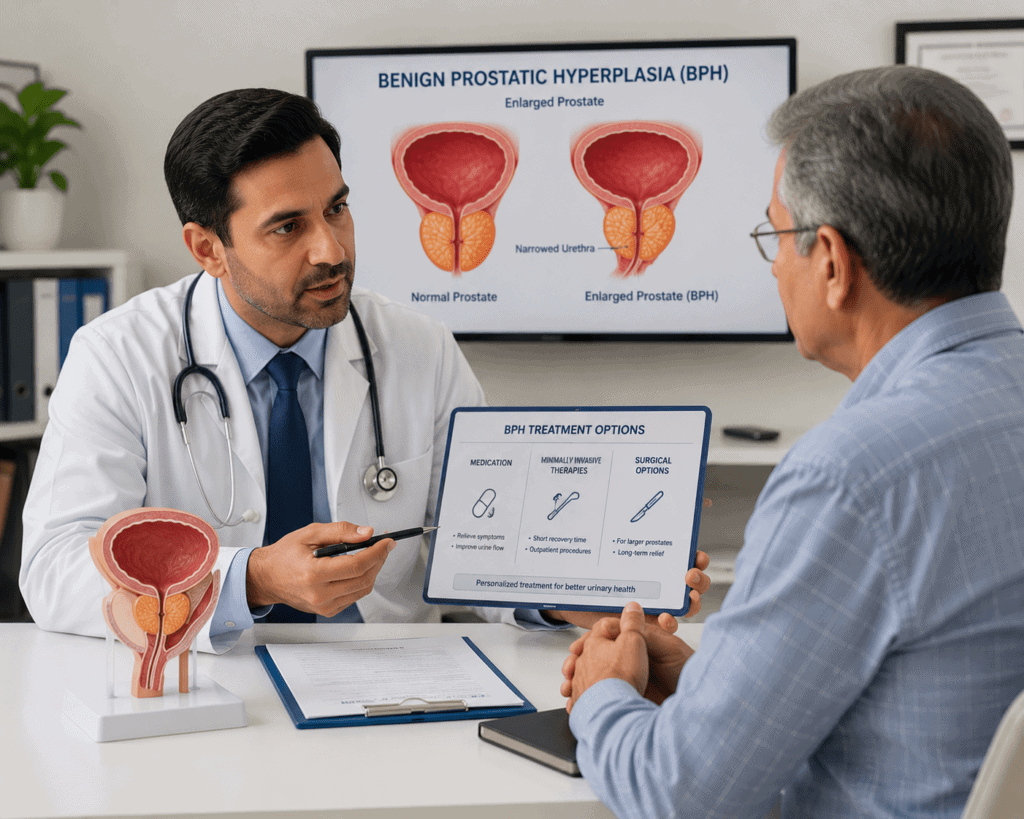
Goals of BPH Treatment
The primary goals of treatment are:
- Improve urine flow
- Reduce urinary frequency and urgency
- Improve bladder emptying
- Reduce night-time urination
- Prevent urinary retention
- Protect bladder and kidney function
- Improve quality of life
- Reduce the need for emergency treatment
Treatment Journey
Symptoms
↓
Diagnosis
↓
Treatment Selection
↓
Lifestyle or Medication
↓
Minimally Invasive Treatment
↓
Recovery
↓
Follow-up Care
Which BPH Treatment Is Right for You?
There is no single treatment that is best for every patient.
The most suitable option depends on:
- Age
- Symptom severity
- Prostate size
- PSA level
- IPSS Score
- General health
- Existing medical conditions
- Personal preferences
- Sexual function concerns
- Recovery expectations
A detailed consultation helps determine the treatment that offers the best balance between symptom relief, safety, and recovery.
Treatment Decision Flowchart
Mild Symptoms
↓
Lifestyle Changes
↓
Moderate Symptoms
↓
Medication
↓
Persistent Symptoms
↓
UroLift® / Rezūm™ / iTind®
↓
Large Prostate
↓
Laser Surgery / TURP / Other Surgical Options
Statistics
- More than half of men over the age of 50 develop some degree of prostate enlargement.
- Many patients respond well to non-surgical treatment during the early stages.
- Advances in minimally invasive therapies have expanded treatment options for appropriately selected patients.
Medical Review Box
Senior Consultant Urologist
Robotic Uro-Oncology & Minimally Invasive Urology Specialist
Prostate Excellence Centre
Not sure which BPH treatment is right for you? Schedule a consultation with Dr. Priyaddarshi Ranjan for a personalized treatment plan.
Treatment Options for BPH
The treatment for Benign Prostatic Hyperplasia (BPH) depends on the severity of symptoms, prostate size, age, overall health, and personal preferences. While some men experience relief with lifestyle changes or medication, others may benefit from minimally invasive procedures or surgery.
Modern BPH treatment focuses on relieving urinary symptoms, improving quality of life, and preserving normal urinary and sexual function whenever possible.
1. Lifestyle Changes for Mild BPH
Men with mild symptoms may benefit from simple lifestyle modifications before considering medication or procedures.
Recommended Lifestyle Changes
- Reduce caffeine intake
- Limit alcohol consumption
- Avoid drinking excessive fluids before bedtime
- Maintain a healthy body weight
- Exercise regularly
- Avoid delaying urination
- Practice bladder training
- Manage diabetes and high blood pressure
These measures do not shrink the prostate but may reduce symptom severity and improve bladder function.
2. Medications for BPH
When symptoms become more bothersome, medications may be recommended.
Common types include:
Alpha-Blockers
These medications relax the muscles around the prostate and bladder neck, helping improve urine flow.
5-Alpha Reductase Inhibitors
These medicines work by reducing the effects of hormones that contribute to prostate enlargement. They may be more suitable for men with larger prostates.
Combination Therapy
Some patients benefit from a combination of different medications, depending on symptom severity and prostate size.
Medication should only be started after consultation with a qualified urologist.
3. UroLift® System
The UroLift® System is a minimally invasive treatment designed for selected men with BPH.
Instead of removing prostate tissue, small implants are placed to hold the enlarged prostate tissue away from the urethra, improving urine flow.
Benefits
- No tissue removal
- Minimally invasive
- Usually performed as a day-care procedure
- Rapid recovery
- Preservation of sexual function in appropriately selected patients
Suitable For
- Mild to moderate prostate enlargement
- Men seeking faster recovery
- Patients wishing to avoid long-term medication
4. Rezūm™ Water Vapor Therapy
Rezūm™ uses controlled water vapor (steam) to treat enlarged prostate tissue.
The steam is delivered into the prostate, where it gradually reduces excess tissue over time, improving urinary flow.
Benefits
- Minimally invasive
- Day-care procedure in many cases
- No surgical incision
- Suitable for selected patients
Symptom improvement usually develops gradually as the treated tissue is absorbed by the body.
5. iTind®
The iTind® System is a temporary device designed to reshape the prostate opening and improve urine flow without permanently removing prostate tissue.
Advantages
- Temporary implant
- No permanent foreign material left behind
- Minimally invasive
- Short recovery period
- Suitable for selected patients
6. Laser Prostate Surgery
Laser surgery is commonly recommended for men with moderate to severe BPH, particularly when the prostate is significantly enlarged.
Laser energy removes or vaporizes excess prostate tissue, reducing urinary obstruction.
Advantages
- Effective symptom relief
- Reduced bleeding compared with some traditional procedures
- Suitable for many patients taking blood-thinning medication (depending on individual circumstances)
7. TURP (Transurethral Resection of the Prostate)
TURP has been used for many years as a standard surgical treatment for BPH.
During the procedure, excess prostate tissue is removed through the urethra without external incisions.
TURP remains an effective option for selected patients with significant urinary obstruction.
8.PAE (Prostatic Artery Embolization)
Prostatic Artery Embolization (PAE) is a minimally invasive procedure performed by an interventional radiologist.
The blood supply to specific areas of the prostate is reduced, causing the gland to shrink over time.
PAE may be considered for carefully selected patients after multidisciplinary evaluation.
9. Aquablation Therapy
Aquablation is a robot-assisted procedure that uses a high-pressure water jet to remove excess prostate tissue.
This technology combines imaging guidance with robotic precision and may be appropriate for selected patients.
Availability may vary depending on the treating center.
Comparison Table
| Treatment | Minimally Invasive | Hospital Stay | Recovery | Tissue Removal |
|---|---|---|---|---|
| Lifestyle Changes | ✅ | No | Immediate | ❌ |
| Medication | ✅ | No | Ongoing | ❌ |
| UroLift® | ✅ | Usually Day Care | Fast | ❌ |
| Rezūm™ | ✅ | Usually Day Care | Short | Minimal (through tissue ablation) |
| iTind® | ✅ | Usually Day Care | Fast | ❌ |
| Laser Surgery | No | Usually 1–2 Days | Moderate | ✅ |
| TURP | No | Usually 2–3 Days | Moderate | ✅ |
| PAE | ✅ | Usually Day Care | Moderate | ❌ |
| Aquablation | No | Usually 1–2 Days | Moderate | ✅ |
Which BPH Treatment Is Right for You?
There is no single treatment that is ideal for every patient.
The best option depends on:
- Prostate size
- Severity of symptoms
- Age
- General health
- PSA level
- IPSS score
- Existing medical conditions
- Lifestyle
- Personal preferences
- Individual treatment goals
A detailed consultation with an experienced urologist helps determine the most appropriate treatment plan.
Doctor's Expert Advice
Choosing a treatment based only on internet research can be misleading. Every patient’s condition is different. A thorough evaluation—including symptom severity, prostate size, and overall health—is essential before deciding on the most appropriate treatment option.
Which BPH Treatment Is Best?
There is no single treatment that is considered the best for every patient with Benign Prostatic Hyperplasia (BPH). The most appropriate option depends on several factors, including the size of the prostate, severity of urinary symptoms, overall health, age, and personal preferences.
A personalized evaluation by an experienced urologist is essential before choosing a treatment.
How Doctors Choose the Right BPH Treatment
Your urologist considers several important factors before recommending treatment.
These include:
- Severity of urinary symptoms
- International Prostate Symptom Score (IPSS)
- Prostate size
- PSA level
- Urine flow rate
- Residual urine volume
- Age
- General health
- Current medications
- Personal treatment goals
- Preference for minimally invasive procedures
- Recovery expectations
No single factor determines treatment. Instead, all findings are considered together.
BPH Treatment Decision Guide
| Condition | Recommended Approach |
|---|---|
| Mild symptoms | Lifestyle changes and regular monitoring |
| Mild to Moderate symptoms | Lifestyle changes ± Medication |
| Moderate symptoms affecting quality of life | Medication or minimally invasive treatment |
| Persistent symptoms despite medication | UroLift®, Rezūm™, iTind®, or other suitable procedures |
| Large prostate with significant obstruction | Laser surgery or TURP (depending on individual evaluation) |
| Complications such as urinary retention | Advanced procedural or surgical treatment after evaluation |
Recovery After BPH Treatment
Recovery varies depending on the treatment selected.
Lifestyle Changes
- Resume normal activities immediately.
Medication
- No recovery period.
- Regular follow-up is recommended to assess symptom improvement.
UroLift®
- Most patients return to normal activities within a few days.
- Temporary urinary symptoms may occur during the initial recovery period.
Rezūm™
- Symptom improvement develops gradually over several weeks as treated tissue is absorbed.
- Temporary urinary irritation may occur after the procedure.
iTind®
- Recovery is generally quick.
- The temporary device is removed after the recommended treatment period.
Laser Surgery
- Recovery usually takes several weeks.
- Follow your doctor’s advice regarding activity and follow-up care.
TURP
- Recovery generally takes several weeks.
- Temporary urinary symptoms may occur during healing.
Recovery Timeline
| Treatment | Return to Routine Activities* |
|---|---|
| Lifestyle Changes | Same day |
| Medication | No recovery period |
| UroLift® | Usually within a few days |
| Rezūm™ | Gradual improvement over several weeks |
| iTind® | Usually within a few days after device removal |
| Laser Surgery | Several weeks |
| TURP | Several weeks |
*Recovery varies depending on individual health, treatment type, and your doctor’s advice.
Benefits of Early BPH Treatment
Seeking treatment before symptoms become severe offers several potential advantages.
Early treatment may help:
- Improve urine flow
- Reduce frequent urination
- Improve sleep quality
- Reduce urinary urgency
- Lower the risk of urinary retention
- Reduce bladder-related complications
- Improve overall quality of life
- Provide access to a wider range of treatment options
What Happens If BPH Is Left Untreated?
Ignoring persistent urinary symptoms may increase the risk of complications.
Possible complications include:
- Acute urinary retention
- Recurrent urinary tract infections
- Bladder stones
- Blood in urine
- Bladder damage
- Kidney damage in advanced cases
- Progressive worsening of urinary symptoms
Not every patient develops complications, but timely evaluation helps reduce these risks.
Questions to Ask Your Urologist
Before deciding on treatment, consider asking:
- Which treatment is most suitable for my prostate size?
- Do I need medication or a procedure?
- What are the benefits and risks of each option?
- How long will recovery take?
- Will treatment affect urinary function?
- Will treatment affect sexual function?
- How often will I need follow-up?
- What happens if I delay treatment?
Common Myths About BPH Treatment
Myth 1: Every Patient Needs Surgery
Fact: Many men improve with lifestyle changes, medication, or minimally invasive procedures.
Myth 2: Medication Works for Everyone
Fact: Treatment effectiveness varies. Some patients may require a procedure if symptoms persist.
Myth 4: Treatment Always Affects Sexual Function
Fact: The potential impact varies by treatment. Your urologist will discuss expected benefits and possible side effects based on the recommended option.
Quick Comparison
| Feature | Medication | UroLift® | Rezūm™ | iTind® | Laser | TURP |
|---|---|---|---|---|---|---|
| Minimally Invasive | No | Yes | Yes | Yes | No | No |
| Tissue Removal | No | No | Yes (ablated tissue) | No | Yes | Yes |
| Hospital Stay | No | Usually Day Care | Usually Day Care | Usually Day Care | Usually 1–2 Days | Usually 2–3 Days |
| Recovery | Ongoing | Fast | Moderate | Fast | Moderate | Moderate |
Doctor's Expert Advice
The best BPH treatment is not necessarily the newest or the most commonly advertised. The right treatment is the one that matches your symptoms, prostate size, health status, and personal goals. A thorough consultation ensures that the chosen treatment is appropriate for your individual condition.
Which Treatment Is Right for Me?
| If You… | You Should Discuss With Your Urologist |
|---|---|
| Have mild symptoms | Lifestyle changes or medication |
| Want to avoid long-term medication | UroLift®, Rezūm™, or iTind® (if suitable) |
| Have a larger prostate | Laser surgery or TURP (depending on evaluation) |
| Have persistent symptoms despite medication | Minimally invasive or surgical options |
| Have urinary retention or complications | Advanced procedural or surgical treatment |
Frequently Asked Questions
1. What is the best treatment for BPH?
The best treatment depends on several factors, including the severity of symptoms, prostate size, age, overall health, and personal preferences. Some men benefit from lifestyle changes or medication, while others may be suitable candidates for minimally invasive procedures or surgery. A detailed evaluation by a urologist is essential before deciding on treatment.
2. Can BPH be treated without surgery?
Yes. Many men with mild to moderate symptoms can be managed with lifestyle changes, medication, or minimally invasive treatments. Surgery is usually considered only when symptoms are severe or complications develop.
3. Which treatment has the fastest recovery?
Recovery varies between individuals and treatment types. Many minimally invasive procedures allow patients to return to normal activities sooner than traditional surgery, although the most appropriate treatment depends on the patient’s overall clinical evaluation.
4. Is medication enough to treat BPH?
Medication can effectively control symptoms in many patients, particularly during the early stages. However, some men may require procedural treatment if symptoms persist or worsen despite medication.
5. Is BPH treatment permanent?
Treatment can significantly improve urinary symptoms, but long-term outcomes depend on the treatment chosen, prostate characteristics, and individual patient factors. Regular follow-up is important.
6. Does BPH treatment affect sexual function?
The potential impact varies depending on the treatment. Your urologist will explain the expected benefits and possible side effects of each option before treatment.
7. When should surgery be considered?
Surgery may be recommended when symptoms are severe, complications develop, or less invasive treatments are not appropriate or have not provided adequate symptom relief.
8. Can lifestyle changes improve BPH?
Yes. Healthy lifestyle habits such as maintaining a healthy weight, exercising regularly, reducing caffeine and alcohol intake, and managing chronic conditions may help improve urinary symptoms.
9. How long does recovery take?
Recovery depends on the treatment performed. Some minimally invasive procedures have relatively short recovery periods, while surgical procedures generally require a longer recovery.
10. Should I consult a urologist before choosing treatment?
Yes. Every patient is different. A detailed evaluation helps determine the most suitable treatment based on symptoms, prostate size, overall health, and personal goals.
Why Choose Dr. Priyaddarshi Ranjanfor BPH Treatment?
Choosing the right specialist is an important part of successful treatment.
Dr. Priyaddarshi Ranjan provides comprehensive evaluation and personalized treatment planning for men with Benign Prostatic Hyperplasia.
Highlights
- Experienced Urologist
- Advanced BPH Management
- Evidence-Based Treatment Planning
- Personalized Treatment Approach
- Focus on Patient Education
- Modern Diagnostic Evaluation
- Minimally Invasive Treatment Expertise
- Long-Term Follow-up Care
Your Journey to Better Urinary Health
Every patient’s journey is unique, but timely evaluation and treatment can significantly improve urinary symptoms and quality of life.
Patient Journey
Symptoms

↓

Consultation

↓

Diagnosis

↓

Treatment Selection

↓

Procedure (If Required)

↓

Recovery

↓

Follow-up Care
Conclusion
Benign Prostatic Hyperplasia is a common condition that affects millions of men worldwide. Fortunately, advances in modern urology have made it possible to treat BPH using a wide range of options, from lifestyle modifications and medications to minimally invasive procedures and surgery.
The most appropriate treatment depends on careful evaluation rather than a one-size-fits-all approach. Seeking medical advice early allows more treatment choices and may help prevent long-term complications.
If you are experiencing urinary symptoms that interfere with your daily life, consult an experienced urologist to discuss the treatment options that best match your condition and health goals.
A New Era in Healthcare
Practicing At
Prostate Excellence centre, Meliora Institute of kidney, Urology and Men’s health, SCO-152, Ground Floor, Sector 24 D, Chandigarh
Get Expert BPH Treatment
Don’t let urinary symptoms affect your quality of life.
Receive a personalized evaluation and discuss the most appropriate treatment options with Dr. Priyaddarshi Ranjan, an experienced urologist specializing in enlarged prostate management.